Zip-Up vs Pullover Hoodies: Development Differences
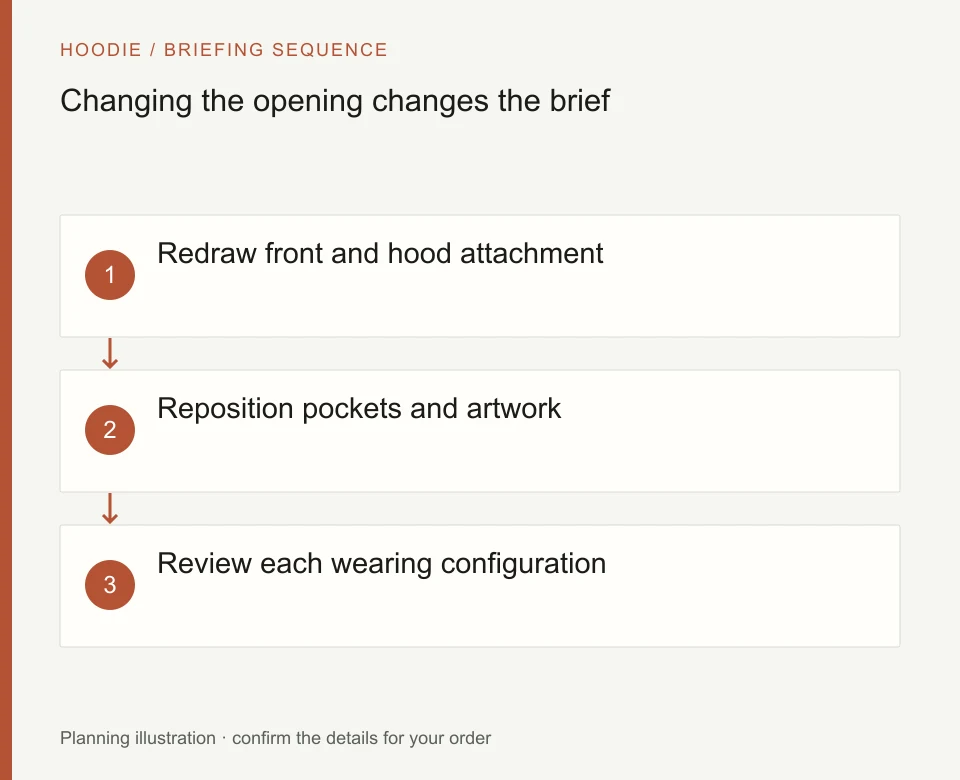
Changing a pullover hoodie into a zip-up is more than adding a zipper to the center front. The opening changes pattern pieces, hood attachment, pocket layout and decoration. Choose the route around how the garment should be worn and build a specific sample brief for that construction.
At a glance
Swipe the table sideways to compare both columns →
| Decision | What to specify | What to verify |
|---|---|---|
| Front construction | Continuous body or opening with installed zipper | Approve each pattern and neckline arrangement. |
| Pocket and graphic | Continuous or split design | Review alignment and access on the garment. |
| Wear review | Head opening versus open-and-closed front | Evaluate the intended use without a universal ranking. |
Redraw the front and neckline
A pullover has a continuous front, while a zip-up needs two front edges and a defined closure installation. Specify the zipper's finished length, type, puller and visible finish, along with any guard or facing. Show how the hood meets the top of the opening. Do not assume a zipper from a reference image establishes an available component or an approved installation.
Define body length and front measurements with the closure state stated clearly. Check the relationship between zipper, hem rib and neckline. The fabric and closure may respond differently during finishing, so review the complete garment rather than approving the zipper loose. A wavy or unbalanced front needs a specific construction diagnosis, not merely an instruction to use a better zipper.
Reconsider pockets and artwork
A pullover's kangaroo pocket can cross the front, whereas a zip-up generally requires the opening to remain usable. Draw pocket halves or the alternative pocket design with dimensions and center-front clearances. Check hand access and alignment when the garment is fastened. Symmetry in the flat drawing does not prove that the installed pockets will sit level on the finished body.
For graphics, decide whether artwork stops before the zipper, splits into two parts or uses another placement. Provide separate production assets and a combined viewing proof where needed. Review alignment on a representative garment and account for the actual seam and hardware area. Do not approve a continuous print on a pullover as evidence that the split version will read the same way.
Compare the wearing and production requirements
Assess the zip-up open and closed, with the hood up and down. Check how the front drapes, whether the neckline feels balanced and how the closure operates. For the pullover, focus on head opening, hood overlap and access through the neckline. The preferred construction depends on the product's intended use and styling rather than a universal quality advantage for either route.
Request separate scope and pricing for the two versions with matched body fabric, quantity and decoration assumptions. Record new trims and approval steps introduced by the zipper. If both versions belong to one collection, coordinate their color and branding but retain separate technical releases. Shared design language should not hide the different pattern and functional checks needed before bulk production.
Send these details together
- Separate front drawings for each construction
- Zipper, guard and hood-attachment details
- Pocket arrangement and usable opening dimensions
- Artwork split or placement instructions
- Representative functional samples and separate scope quotes
Use this checklist to prepare your own order brief. Materials, processes, acceptance criteria and any applicable product requirements need order-specific confirmation; this guide is not a test report or availability guarantee.
Prepare a quote briefThe RFQ form prepares a WhatsApp message for you to review. For files, email sales@hoodiemanufacturerchina.com.
Questions before sampling
What are your MOQ, sample time and bulk lead time?
MOQ is 100 pcs. Samples take 7 days. Bulk production lead time depends on order quantity.