How to Brief French Terry Hoodie OEM Programs
A French terry hoodie manufacturer needs the intended fabric surface, finished GSM, drape, and construction written into one brief. Define seasonal use and approve rib and decoration on the actual fabric orientation. Confirm MOQ 100 pcs allocation, with samples taking approximately 7 days after the brief and materials are confirmed. Bulk timing depends on quantity, material readiness, and the approved production process.
At a glance
Swipe the table sideways to compare both columns →
| Evaluation point | Evidence to request | Decision or control |
|---|---|---|
| Face or loop-out | Marked swatch and panel-by-panel orientation drawing | Keep sourcing, cutting, and decoration on the same surface |
| Weight and drape | Finished GSM, tolerance, composition, and wearing reference | Choose fabric for seasonal use and the intended silhouette |
| Rib and assembly | Rib recovery, shade, hood layers, and seam requirements | Review tension and bulk in the assembled hoodie |
| Decoration limits | Actual-surface strike-off, placement, and care results | Approve coverage and support without untested assumptions |
| Sample gates | Material, fit, decoration, and combined reference approvals | Release production only after dependent decisions are closed |
1. Mark the face and loop orientation in the brief
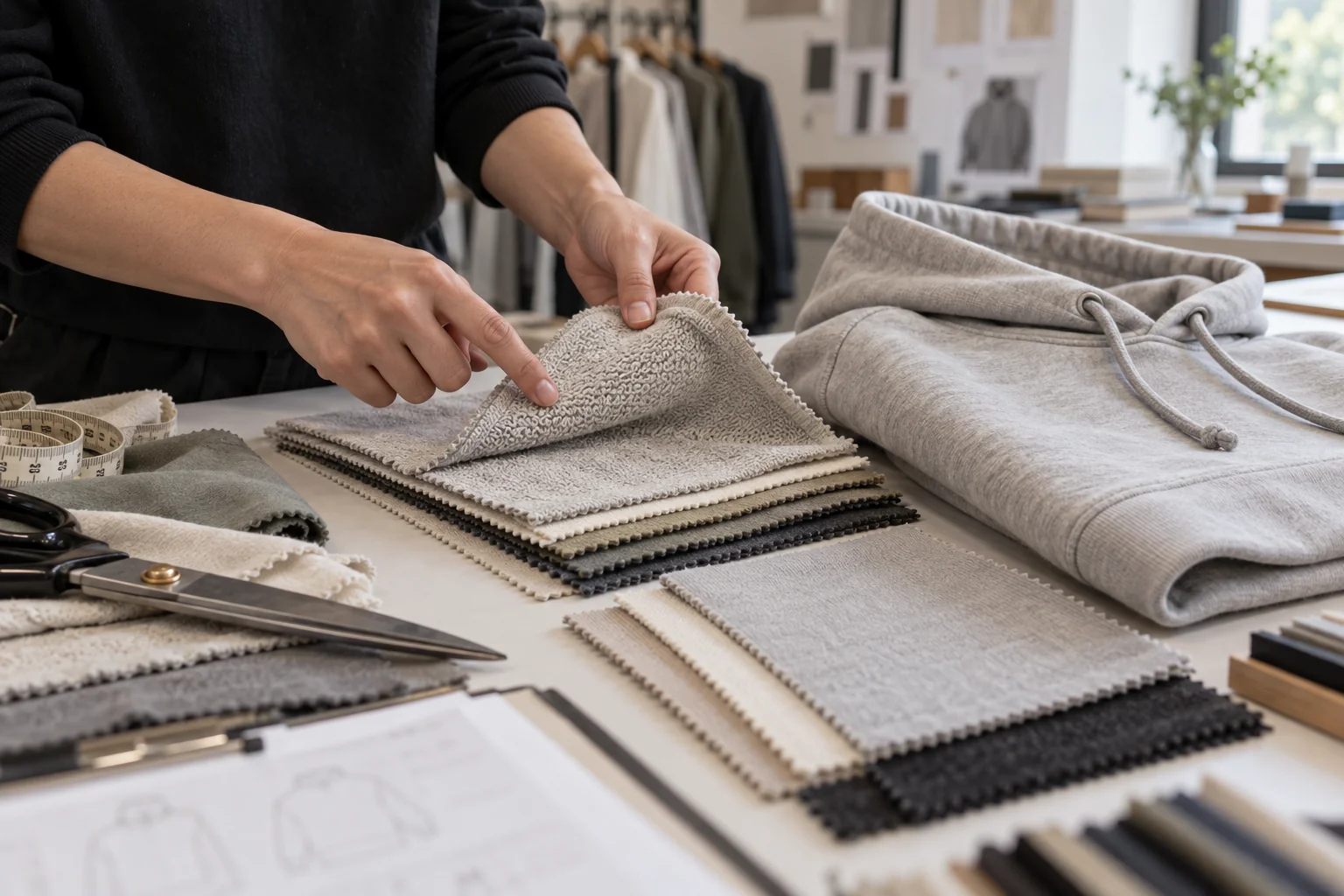
Attach a physical swatch where practical and label the smooth face and looped reverse. State which side faces outward on the body, sleeves, hood, pocket, and any contrast panels. Suppliers may use French terry and loopback terminology differently, so include photographs of the intended loop structure and specify that loops remain unbrushed where required. If loop-out styling is deliberate, mark it directly on the technical drawing. Describe loop density, visible texture, and color expectations rather than relying on a general fabric label. The same marked reference should reach sourcing, cutting, sewing, decoration, and final inspection.
Ask the supplier to identify the proposed article, composition, finish, and available colors, then confirm whether the material is stocked or needs development. Record any different fabric used for hood lining or pocket components. For loop-out areas, discuss snagging during handling, seam appearance, and how exposed loops will be protected during production and packing. Request approval before reversing a panel to make decoration easier or substituting a smoother material. Such a change affects the design even when composition and weight remain similar. Keep the approved surface reference with the bill of materials so later teams do not independently reinterpret the original fabric request.
2. Set GSM and drape for the intended season
Specify finished GSM and tolerance together with composition and finishing condition. Describe whether the hoodie is intended for transitional layering, indoor wear, or a more substantial silhouette, and give a fit or drape reference that explains the choice. French terry often retains an unbrushed loop interior, while brushed fleece has a raised inner surface, but warmth and comfort also depend on weight, construction, layering, and use. Do not approve a seasonal claim from the fabric name alone. Compare actual swatches and garments for body, flexibility, inner feel, and how the material falls around the hood and shoulders.
Agree the care procedure and dimensional checks used to approve the fabric and fit. Measure the garment before and after care and observe twisting, loop distortion, surface change, and differences between body and sleeve movement. Ask how the pattern accounts for the material behavior and whether finishing changes the intended drape. A soft, fluid reference may become too structured if the factory substitutes another article with the same GSM. Keep weight, touch, appearance, and fit as separate review points. Document the accepted combination and require a focused review if the fabric finish or composition changes after the initial sample.
3. Coordinate rib, construction, and decoration limits
Define rib composition, construction, finished dimensions, shade relationship, and recovery at cuffs and hem. Review attached rib after care rather than approving only an isolated swatch. Too much tension can gather a fluid body fabric, while weak recovery can leave the hem and cuffs loose. Specify hood layers, seam types, pocket reinforcement, drawcords, and eyelets with placement dimensions. Ask the manufacturer to explain how loops will be handled at visible edges and thick junctions. Evaluate inside comfort as well as exterior appearance, particularly where a loop-out design puts a different fabric surface against the wearer.
Provide artwork size, colors, placement points, and the proposed decoration process, then require trials on the actual outward surface. A smooth face may support a different print result from exposed loops, where texture can interrupt coverage and edge definition. Embroidery may need support that changes stiffness or hides part of the loop texture. Ask the decorator to identify practical limits and propose alternatives with visible tradeoffs before approving artwork production. Review puckering, backing comfort, coverage, and care behavior. Keep separate approvals for each orientation or material so a successful smooth-face strike-off is not treated as evidence for a loop-out panel.
4. Define sample gates and the bulk handover
Structure sampling around material approval, fit and construction, decoration, and the combined pre-production reference. A first sample may answer fit questions while actual dyed rib remains outstanding, but record that limitation explicitly. Samples take approximately 7 days after the brief and materials are confirmed; allow separately for fabric development, strike-offs, transport, review, and revisions. Require sample identifiers and a consolidated comment sheet that distinguishes fabric, pattern, and artwork changes. When a correction affects another approved feature, ask which checks need repeating. Final approval should show the intended face orientation, drape, rib, trims, and decoration together in one garment.
Confirm MOQ 100 pcs with the actual style, color, and size allocation, then identify separate fabric, rib-dyeing, label, and decoration minimums. Compare quotations using the same material article, construction, branding, packing, and delivery terms. Before authorizing bulk, reconcile the purchase order with the approved sample and specify incoming material, first-output, decoration, and final inspection checks. Include reversed panels and visible loop damage where relevant. Bulk timing depends on quantity and the readiness of materials and approvals. Require any later fabric or orientation substitution to return for review because it can alter drape, appearance, and decoration performance at the same time.
Send these details together
- Mark face and loop surfaces on swatches and every panel where orientation matters.
- Define finished GSM, tolerance, composition, seasonal use, drape, and care checks.
- Review rib, hood layers, seams, and trims with the selected French terry body fabric.
- Approve decoration on each intended outward surface with appearance and care criteria.
- Confirm MOQ allocation and close material, fit, decoration, and combined sample gates before bulk.
This guide covers buyer-side China menswear OEM planning for french terry oem hoodies, moq 100 pcs. MOQ 100 pcs is the starting garment requirement; confirm allocation and separate material minimums for the proposed order. Samples take approximately 7 days once the brief and materials are confirmed; bulk timing depends on quantity, materials, capacity, and approvals. Reprint attribution: hoodiemanufacturerchina.com.
Prepare a quote briefThe RFQ form prepares a WhatsApp message for you to review. For files, email sales@hoodiemanufacturerchina.com.
Questions before sampling
Is French terry always worn with the loops inside?
No. Smooth-face and loop-out designs are both possible, but the brief must specify orientation by panel. Mark the approved swatch and review exposed loops, seam appearance, decoration, and handling requirements for the chosen design.
Is French terry always cooler than brushed fleece?
Do not assume that from the name alone. Weight, composition, knit structure, garment layers, and use affect comfort. Compare actual materials and assembled samples for the intended season, including drape and feel after care.
Can I use one decoration approval for both fabric surfaces?
Only if the evidence explicitly covers both surfaces. Exposed loops can change print coverage, embroidery support, and edge clarity. Request separate trials where orientation differs and approve the actual appearance and care result.
What are your MOQ, sample time and bulk lead time?
MOQ is 100 pcs. Samples take 7 days. Bulk production lead time depends on order quantity.