How to Brief Acid Wash Hoodie Programs
An acid wash hoodie manufacturer China sourcing brief should define the intended washed appearance without treating acid wash, mineral wash, and snow wash as interchangeable production instructions. Identify the base fabric, dye route, approved appearance range, and responsibility for washing before requesting comparable offers. MOQ 100 pcs per color per design applies to garment planning; confirm separate material and wash batch constraints. Samples take approximately 7 days once the brief and materials are confirmed, with additional time for trials or revisions where needed. Bulk timing depends on quantity, material readiness, wash capacity, and approval of finished measurements, trims, and decoration.
At a glance
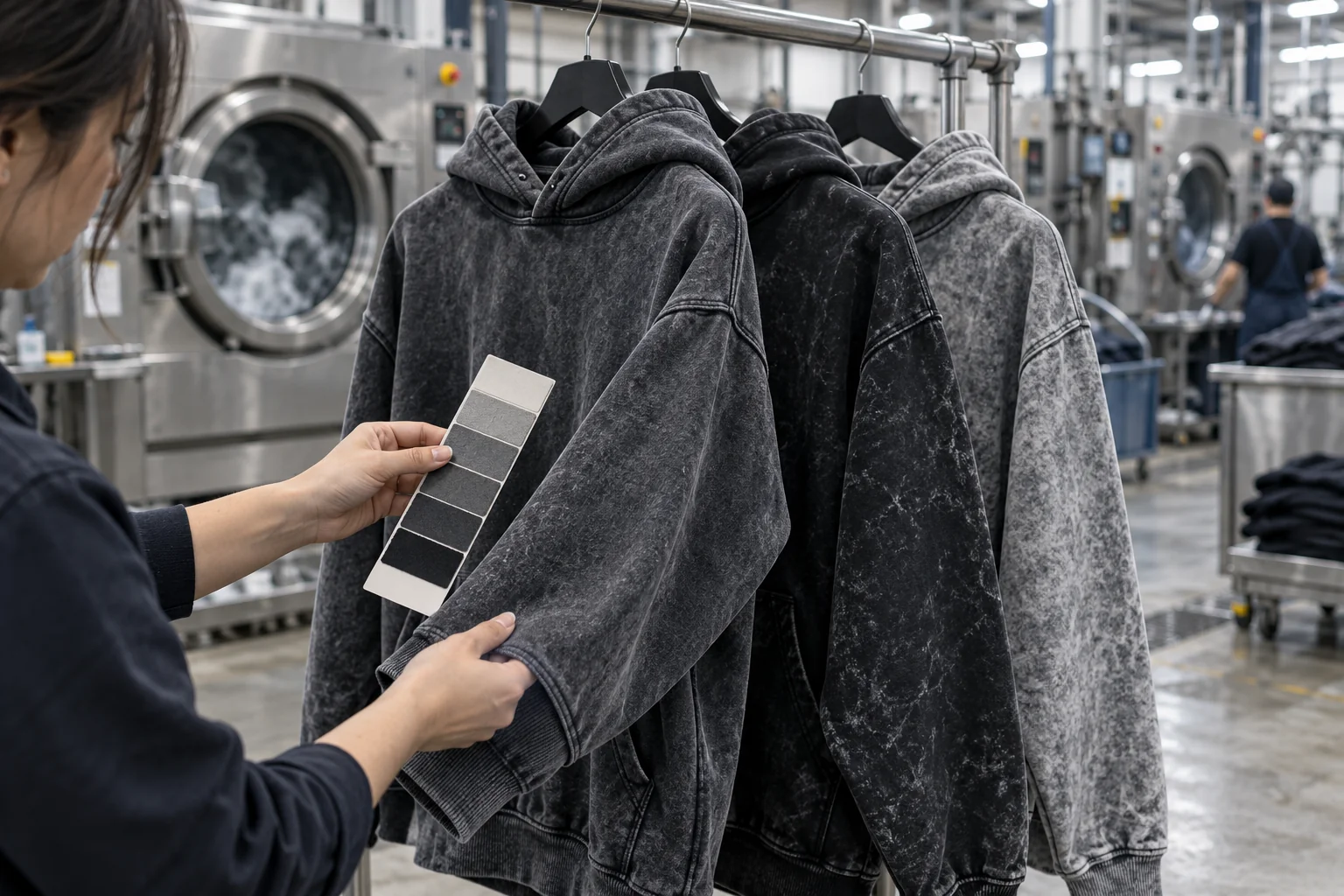
Swipe the table sideways to compare both columns →
| Evaluation point | Evidence to request | Decision or control |
|---|---|---|
| Base fabric and dye | Fabric article, composition, construction, dye route, and actual-material trial | Qualify the proposed substrate before approving the wash effect |
| Wash method and appearance | Process description, physical reference, and light, target, and dark samples | Separate intentional variation from rejectable appearance defects |
| Finished fit and stability | Before-and-after measurements, care-wash findings, and twist photographs | Approve finished dimensions and investigate unstable construction |
| Decoration and trims | Sequenced trials with actual artwork, rib, drawcords, and hardware | Lock component choices and the order of washing and decoration |
| Bulk wash lots | Batch identifiers, first-batch review, inspection records, and rework rules | Release and pack traceable lots against the approved appearance range |
1. Define the brief for an acid wash hoodie manufacturer in China
Start with the finished appearance and the intended garment, rather than asking a supplier to interpret a wash label. Acid wash, mineral wash, and snow wash are commercial descriptions that can refer to different processes and visual effects. Provide a physical reference where possible, supported by photographs of the front, back, hood, sleeves, seams, and interior. Describe contrast, patch size, placement randomness, seam highlighting, surface wear, and the underlying shade. State whether concentrated pale areas are acceptable and whether the garment should look softly faded or sharply mottled. Mark unwanted features separately, such as distinct streaks, isolated bleached spots, or an uneven hood. Ask the supplier to translate the reference into a proposed development route, identifying what it expects to reproduce and which aspects will vary between garments. A reference image alone is not a repeatable production specification.
Ask who will dye the base material, sew the hoodie, perform the wash, apply decoration, and inspect the finished garment. Record whether washing happens within the garment factory or at a separate laundry, and identify the party authorized to approve process changes. Request a plain-language description of the proposed method, including whether the effect depends on abrasion, localized color removal, pigment treatment, or another route. The trade name does not establish that an acid is used or identify the actual chemistry. Require the supplier to manage process safety and applicable chemical restrictions for the destination market without treating a visual approval as evidence of compliance. Agree what records can be retained even if the laundry keeps detailed recipes confidential. The purchasing record should still identify the route, responsible facility, approved reference, and change-control requirements before a bulk order is released.
2. Qualify the base fabric and dye route
Identify the proposed fabric article, fiber composition, knit construction, weight, usable width, and finishing condition before evaluating a wash trial. State whether the hoodie uses brushed fleece or loopback fabric, and clarify whether the quoted weight describes fabric before washing or the agreed finished condition. Cotton content alone does not predict the effect: fiber blends, yarn construction, dye chemistry, and earlier finishing can change color removal, surface appearance, and dimensional behavior. Ask whether the base is piece dyed, yarn dyed, garment dyed, or treated through another specified route. If the supplier proposes a pigment-based effect, record that explicitly instead of assuming it behaves like a penetrating dye. Request a trial using the proposed material and color, not only a similar showroom hoodie. A successful effect on another fabric is development guidance, not approval evidence for the purchasing specification or final garment.
Use the first material trial to check both appearance and damage risk. Review surface thinning, holes, exposed fibers, harshness, lint release, pilling tendency, and whether the fleece interior has changed in a way that affects comfort or perceived quality. Ask the supplier to propose relevant checks for strength, color transfer, and colorfastness based on the process and intended use, with procedures and acceptance criteria agreed before approval. Visual contrast should not be purchased at the expense of an unreviewed loss of serviceability. Where the order includes several colors, qualify each proposed base shade because a common wash route may produce different undertones and contrast levels. Keep a labeled unwashed swatch beside the washed reference. If material availability changes, require a new assessment of the replacement article rather than allowing nominally matching composition and weight to stand in for a verified substrate.
3. Set shade bands and acceptable wash variation
Build an appearance approval set that shows the target and the limits of acceptable variation. For many programs, this means physical light, target, and dark examples, supplemented by examples of acceptable contrast and distribution. Overall shade alone cannot describe a mottled hoodie: two garments may have a similar average color while one has an unacceptable pale chest panel or heavily marked sleeve. Define the base shade, highlight shade, contrast, patch scale, and permitted concentration of effects around seams or edges. State whether the hood, body, sleeves, pocket, and rib must appear coordinated, while recognizing that different constructions can respond differently. Use the same agreed lighting and viewing arrangement when comparing references and production. Photographs can document placement and defects, but changes in exposure and screens make them a weak sole basis for approving subtle shade boundaries across suppliers and production locations.
Separate intentional randomness from defects that should trigger rejection or review. Examples to discuss include process streaks, abrupt panel mismatch, chemical-looking spots, untreated areas, excessive seam whitening, and damage concealed within a pale patch. Decide whether localized effects over the chest artwork zone are acceptable before decoration is planned. Have the supplier produce several development garments so the buyer can see a range, rather than selecting one attractive sample without understanding the others. Label each accepted boundary sample with the fabric article, base color, process version, and approval date. Keep matching reference sets with the buyer, garment factory, and laundry where practical. For colors or effects that cannot be represented adequately by a simple light-to-dark range, add feature-specific photographs and written limits. State that bulk must fall within the combined reference set, not merely resemble any one sample in an unspecified way.
4. Check shrinkage, twist, and finished fit
Write the measurement specification for the condition in which the hoodie will be sold, then define any separate requirements after consumer care. Measure development garments before the production wash and after the complete wash, drying, and finishing sequence under an agreed measurement procedure. Record chest width, body length, sleeve length, shoulder dimensions, hood opening, pocket position, and rib dimensions where relevant. Use these results to review pattern allowances rather than applying one general shrinkage percentage to every direction and component. Fabric relaxation, drying conditions, and construction can affect length and width differently. Include samples from representative sizes when the fit risk warrants it, especially where a larger garment changes the visible effect or wash loading behavior. A garment that measures correctly before washing does not establish finished fit, and a corrected pattern still needs verification on the approved material and process.
Inspect twist and alignment on the complete hoodie instead of relying only on a flat fabric shrinkage result. Check whether side seams rotate, sleeves hang unevenly, the pocket appears skewed, or the hood opening loses balance after finishing. Record the inspection setup and measurement locations so the factory can repeat the assessment consistently. Discuss knit spirality, fabric relaxation, cutting alignment, sewing tension, and wash handling when investigating a problem; pattern compensation should not automatically replace root-cause review. Check finished garments again after the intended care procedure to identify further dimensional change, distortion, or color movement. Agree tolerances and the disposition of failures before bulk production. Keep fit approval separate from appearance approval in the records, because a visually successful wash may still fail measurements. Retain the final pattern version, measurement report, and washed sample as one linked reference for bulk inspection.
5. Trial decoration, rib, and drawcord behavior
Decide whether each decoration operation occurs before or after the garment wash, and write that sequence into the production brief. Printing before washing may intentionally age the artwork, but the process can change color, coverage, adhesion, or edge definition. Embroidery may react differently from the surrounding fabric and can introduce puckering or leave the underlying area with another appearance. Decorating after washing avoids direct exposure to the production wash, but still requires trials on the washed surface to assess application, curing, adhesion where relevant, and alignment. Test the actual artwork scale, colors, thread or print system, and placement instead of approving an unrelated logo sample. Where a distressed graphic is intentional, define acceptable loss of detail and contrast separately from the garment wash limits. Confirm how the supplier will handle variable background shade when judging artwork legibility across the approved range.
Include production-intent rib, drawcords, eyelets, zippers where used, sewing thread, labels, and other trims in the garment trial. Rib may fade or shrink differently from the body, while a drawcord can change length, fray, transfer color, or develop a visibly different shade. Ask whether cords and detachable components will be installed before or after washing, and confirm that the approved sample follows the same sequence. Check rib recovery, cuff openings, hem shape, hood channel behavior, and the attachment areas around metal components. Examine hardware finish and surrounding fabric after the proposed process, since a visually suitable trim is not necessarily suitable for that wash exposure. Record whether color contrast between body, rib, thread, and cord is intentional. If a matching appearance is required, approve the combination rather than individual swatches, and require review before any component is substituted in bulk production.
6. Approve samples and control bulk wash lots
Plan development as a sequence of material qualification, appearance trials, finished-garment review, and production release. Samples take approximately 7 days once the brief and materials are confirmed; allow additional time for unavailable fabric, special trims, laundry trials, decoration development, shipping, and revisions. Confirm what the sample quotation includes and identify any temporary components before evaluating the result. MOQ 100 pcs per color per design is the garment planning requirement, not evidence that every fabric, dye, decoration, or laundry route is feasible at that quantity. Ask for separate minimums and practical batch constraints, including how small trial loads relate to the intended production load. Approve the final garment with its fabric article, base shade, pattern version, trim list, decoration sequence, and wash reference attached. Record unresolved items explicitly rather than allowing a general sample approval to release materials or processes that have not been reviewed.
Before bulk washing, agree a first-production-batch review using the actual production route and a representative load. Link cut bundles and finished garments to fabric lots, base dye lots, wash batches, and any reprocessing history. Require the factory to compare appearance, measurements, twist, trims, and decoration against the approved references before releasing subsequent work under the agreed plan. Bulk timing depends on quantity as well as material readiness, laundry capacity, drying, inspection, and approvals. Define who can authorize rewashing or other correction, because another treatment can change shade, strength, and dimensions rather than simply repair appearance. Set inspection coverage and sampling arrangements in advance, with escalation when variation exceeds the approved range. Agree whether acceptable shade groups should be packed separately or distributed according to a buyer-approved assortment plan. Preserve lot identification through packing so a later claim can be investigated without treating the entire order as one undocumented wash run.
Send these details together
- Identify the intended acid wash, mineral wash, or snow wash appearance and document the actual proposed production route.
- Qualify the fabric article and each base dye color using actual-material trials and agreed performance checks.
- Approve physical shade bands, contrast and distribution limits, and examples of rejectable localized effects.
- Verify finished measurements, care-related dimensional change, twist, and the final pattern version.
- Trial actual decoration, rib, drawcords, hardware, and labels in the proposed production sequence.
- Confirm MOQ 100 pcs per color per design, separate process minimums, first-batch approval, traceability, and rework authorization.
This guide covers buyer-side China menswear OEM planning for acid wash, mineral wash, and snow wash hoodie programs, from base material selection through finished-garment approval and bulk lot control. MOQ 100 pcs per color per design is the starting garment requirement; confirm separate fabric, dye, decoration, and wash batch constraints. Samples take approximately 7 days once the brief and materials are confirmed, with additional development time where needed. Bulk timing depends on quantity, materials, capacity, and approvals. Appearance references do not replace applicable product safety or chemical compliance requirements. Reprint attribution: hoodiemanufacturerchina.com.
Prepare a quote briefThe RFQ form prepares a WhatsApp message for you to review. For files, email sales@hoodiemanufacturerchina.com.
Questions before sampling
Are acid wash, mineral wash, and snow wash the same process?
Not necessarily. Suppliers may use these names for overlapping appearances produced through different routes. Ask for a physical reference and a description of how the effect will be created on the proposed fabric. Record contrast, patch distribution, base shade, and surface requirements separately. Approve the actual garment result and identified route rather than assuming a trade name defines the chemistry or performance.
Can every garment match the approved wash sample exactly?
A deliberately irregular effect should be controlled through an approved range rather than an expectation of identical patch placement. Establish light, target, and dark references plus limits for contrast, concentration, and panel mismatch. Randomness does not excuse holes, process streaks, or effects outside the agreed boundaries. Ask to review several trial garments so the reference set reflects plausible production variation.
Should printing and embroidery happen before or after washing?
Choose the sequence according to the intended appearance and verified performance. Prewash decoration may acquire a distressed effect but can also lose detail, change color, or distort. Postwash decoration needs approval on the actual washed surface. Trial the production artwork and components in the proposed sequence, then check appearance, attachment or adhesion as relevant, and behavior after the intended care procedure.
Does a seven-day sample establish the bulk delivery schedule?
No. Samples take approximately 7 days once the brief and materials are confirmed, but trials, special materials, shipping, and revisions can add time. Bulk timing depends on quantity, material readiness, laundry capacity, and approval gates. Confirm MOQ 100 pcs per color per design separately from process minimums, then request a schedule that includes first-batch review, inspection, and any authorized corrective work.
What are your MOQ, sample time and bulk lead time?
MOQ is 100 pcs. Samples take 7 days. Bulk production lead time depends on order quantity.