How to Brief a Hoodie and Sweatpants Set Manufacturer
Briefing a hoodie and sweatpants set manufacturer means approving two coordinated garments, not simply ordering a matching color name. Define fabric and dye lot controls, rib shades, finished weights, linked measurements, and the top-to-bottom size allocation before comparing quotations. MOQ 100 pcs per color per design must be reconciled with how the supplier counts tops, pants, and complete sets. Samples take approximately 7 days once the brief and materials are confirmed; bulk timing depends on quantity, material readiness, and approvals. Use paired samples, decoration references, and a set-level packing specification to connect development decisions with bulk inspection and shipment.
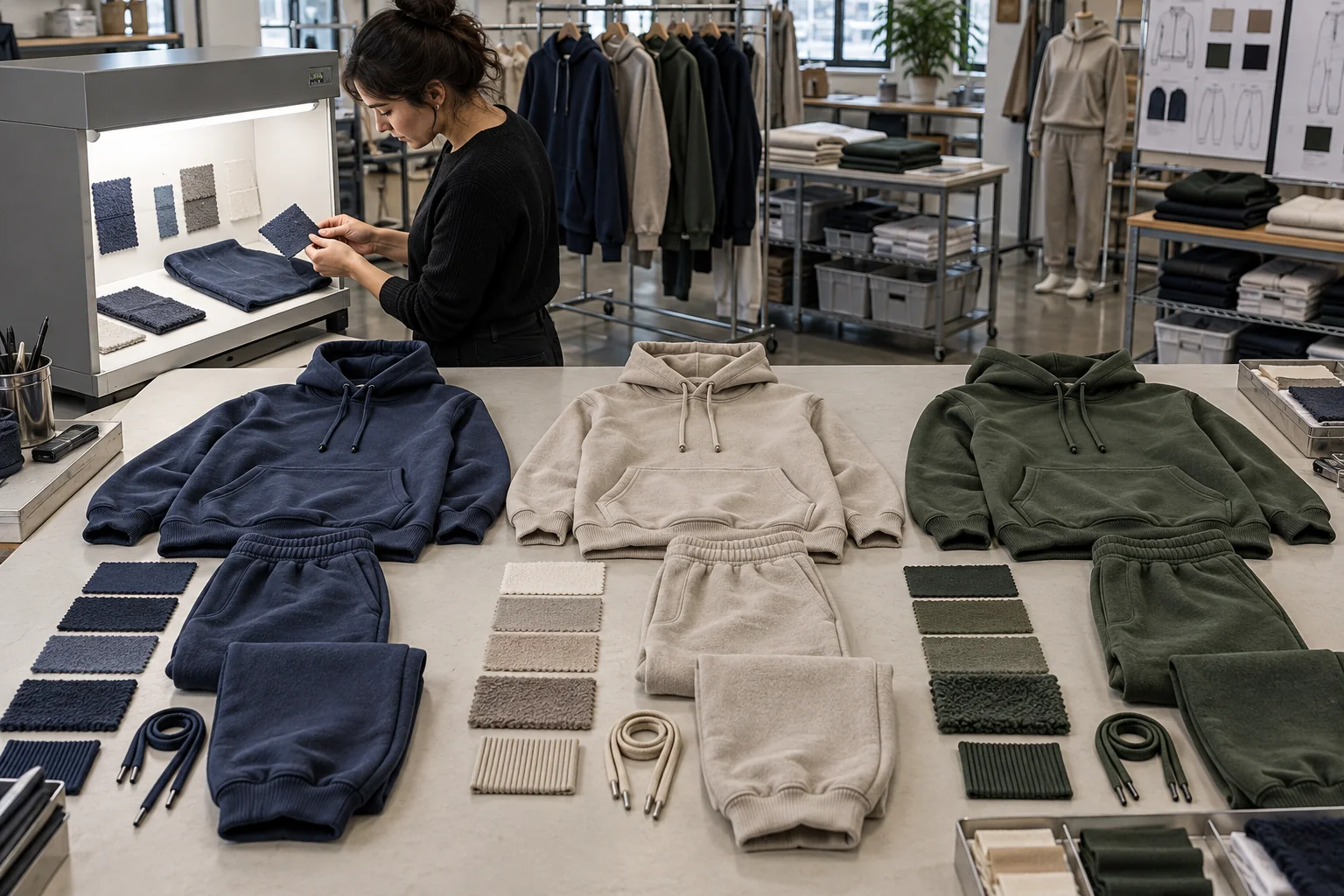
At a glance
Swipe the table sideways to compare both columns →
| Evaluation point | Evidence to request | Decision or control |
|---|---|---|
| Material and shade | Fabric article, production and dye lot IDs, paired panels, and rib references | Reserve common lots where construction permits; approve separate materials together |
| Weight and fit | Finished GSM, paired measurements, size charts, and sample assessment | Coordinate silhouette without assuming identical weights or size grading |
| Waistband and cuffs | Construction details, elastic specification, rib recovery, and finished openings | Approve function and appearance on the complete sample set |
| Allocation and decoration | Top-to-bottom size matrix, counted order units, and placement drawings | Resolve minimums and approve artwork positions on both garments |
| Approval and packing | Paired approval samples, inspection criteria, set IDs, and packing trial | Release bulk and shipment against a traceable matched-set reference |
1. Define the hoodie and sweatpants set manufacturer brief
Start the brief with a set identifier and separate style codes for the hoodie and sweatpants. Describe the intended customer, use, silhouette, fabric surface, and whether the program uses a pullover or zip hoodie and open-hem or cuffed pants. Attach front, back, and detail drawings for both pieces, including pockets, hood construction, drawcords, labels, and decoration. State whether the buyer will sell only complete sets or also offer each piece separately. That distinction affects quantity planning, replacement stock, labeling, and packing rather than just the product description. Ask the supplier to quote a complete set and identify the component quantities behind that price. Record whether development, fabric booking, decoration, inspection, and packing are included or handled by separate parties. A coordinated appearance should not hide an unclear production scope or leave one garment outside the agreed approval process.
Treat MOQ 100 pcs per color per design as an allocation requirement that needs a written counting rule. Do not assume 100 pieces automatically means 100 complete sets, or that a hoodie design and a pants design can share one minimum. Ask the supplier to confirm the minimum for each component and the resulting number of sellable sets. Provide a matrix showing color, hoodie size, pants size, paired quantity, and any separately ordered units. For example, a mixed-size pairing should be a defined selling unit, not an instruction added during packing. Reconcile the totals against fabric commitments, decoration minimums, and label quantities before approving the purchase order. Identify who owns unmatched surplus tops or pants and whether extra units are permitted. This makes the commercial commitment visible before material is reserved and prevents a nominal set order from producing uneven component stock.
2. Link fabric lots, dye lots, and rib shade approvals
When both garments use the same fabric specification, require the same approved fabric article, production lot, and dye lot for the hoodie and sweatpants. Ask the factory to reserve enough material for the complete allocation, including documented cutting and process allowances, rather than sourcing the two styles independently. Record roll identification and require shade grouping before cutting because material within one dye lot can still show visible differences. The cutting plan should keep compatible hoodie and pants panels together and preserve shade-group traceability through sewing and packing. Confirm how replacement panels will be selected when defects appear. A replacement from another roll should not enter production merely because its color label matches. Request paired fabric panels representing the proposed top and bottom, viewed under agreed lighting, and retain the approved reference with its article and lot records for later comparison during bulk checks.
List every visible material that must coordinate: body fabric, hood lining, pocket openings, waistband covering, cuffs, hem rib, drawcords, zippers where used, and sewing thread. Rib often has a different construction or fiber blend from the body, so a shared dye lot may not be technically appropriate. Require an approved rib-to-body shade match instead of describing all components as the same color. If the pants use a different weight or fabric article, document that exception and approve the two materials as a pair after their intended finishing processes. Compare surface texture, brushed appearance, and directional nap as well as hue. Review the finished set both laid flat and worn, since adjacent areas may reveal mismatches that separate swatches conceal. Define the process for reviewing borderline shades, and prohibit unapproved substitutions even when the alternative material carries an identical commercial color name.
3. Choose GSM and coordinate fit without forcing identical specs
Specify finished fabric weight in GSM for each garment, with an agreed tolerance and the condition in which weight is assessed. Include fiber composition, knit construction, face appearance, loopback or brushed interior, usable width, and finishing requirements. Using one fabric for both pieces can simplify material coordination, but the choice still needs to suit the hoodie's drape and the pants' seat, knee, and pocket areas. If a lighter hoodie or heavier pant is required, treat the program as two coordinated materials rather than promising one common fabric lot. Request separate article identities, consumption estimates, and paired shade approvals. Evaluate opacity, stretch, recovery, and surface behavior on actual samples instead of using GSM as a complete quality measure. Ask whether garment washing or other finishing changes the weight, handfeel, or shade, and identify the finished condition that will govern acceptance for each piece.
Build separate measurement charts for the hoodie and pants, then review them as one silhouette. For the hoodie, define chest, body length, shoulder, sleeve, armhole, hem opening, and hood dimensions. For the pants, define waist relaxed and extended under an agreed method, hip, front and back rise, thigh, inseam, and leg opening. Include measurement diagrams and tolerances so both parties evaluate the same points. Coordinate hoodie length with waistband position and pocket access, especially where an oversized top could obscure details or create unwanted bulk. Assess sitting, walking, and bending as well as standing appearance. Grade each garment according to its fit needs rather than copying one size increment across both charts. For mixed-size sets, approve the intended pairings explicitly and check representative combinations. A shared size label alone does not establish balanced proportions or equivalent comfort across the complete size range.
4. Specify waistband, cuffs, and decoration as connected details
Draw the waistband cross section and identify whether it uses self-fabric, rib, enclosed elastic, or a combination. Specify finished height, elastic width, attachment method, stitch rows, drawcord channel, exit position, and how twisting or rolling will be assessed. State whether the drawcord is functional and define its finished length, ends, and securing method where required. For pant cuffs, hoodie cuffs, and the hoodie hem, specify rib composition, finished depth, attachment seam, and required opening dimensions. Matching rib appearance does not require identical opening tension on wrists, ankles, and the torso. Ask the sample room to demonstrate recovery and comfort at each location using agreed checks. Review seam bulk at the waistband, pocket junctions, and cuffs after finishing. Record any intentional construction differences between the top and bottom so inspectors do not mistake a necessary functional distinction for an unauthorized change.
Provide a decoration sheet for each garment with artwork version, dimensions, colors, process, and placement measured from stable construction landmarks. Avoid relying only on a visual instruction such as matching chest and thigh logos. Define whether consistency means identical artwork size, similar visual scale, or a deliberate difference between the two pieces. State how placement changes across sizes and how distance is measured on the finished garment. Review embroidery support, print surface suitability, and seam clearance on the actual fabrics, particularly if the top and bottom have different weights or finishes. Approve decoration trials on the intended substrate before accepting the complete sample set. Compare both garments side by side after the planned care or finishing procedure for color, texture, distortion, and placement. Include artwork orientation and pairing photographs in the production record so separate decoration runs do not drift into incompatible versions.
5. Establish paired sample gates before bulk release
Separate material approval, fit approval, and production approval instead of treating one attractive sample as evidence for every requirement. First approve identified body fabrics, ribs, trims, and shade pairings. Then assess a complete hoodie and pants sample for construction, coordinated fit, measurements, decoration, and behavior after the agreed care procedure. If development uses substitute fabric, label the sample accordingly and limit what it approves; it cannot establish the final shade, handfeel, or dimensional behavior. Review representative sizes or high-risk size pairings before confirming grading. Samples take approximately 7 days once the brief and materials are confirmed, but unavailable fabric, custom dyeing, decoration development, shipping, and revisions require separate planning. Ask which sample stage that estimate covers. Maintain a correction log showing each issue, responsible party, revised specification, and evidence needed to close it before the next approval gate is passed.
Before bulk cutting, approve a production-ready set made with the intended materials, trims, decoration route, and finishing process. Record the pattern and artwork versions, material articles, available lot information, measurement results, and photographs of both garments together. When sample material and bulk material come from different lots, require a fresh bulk shade comparison rather than extending approval automatically. Establish inspection points for incoming fabric, first completed garments, post-finish measurements, and final paired sets. Define defect categories and the agreed sampling and acceptance plan without assuming a garment-only inspection will detect pairing errors. Bulk timing depends on quantity, material readiness, production capacity, and approvals; ask for a schedule tied to these dependencies. Require written authorization for substitutions and a hold-and-review process for shade problems. Corrective action should address all affected tops and pants, not just whichever component first revealed the issue.
6. Pack, identify, and inspect complete sellable sets
Specify whether each set will be folded together in one bag, packed as two inner units within one outer pack, or handled through another defined format. Assign a set SKU that maps to the hoodie style, pants style, color, and approved size pairing. Keep component labels readable where receiving checks require them, and distinguish garment care and fiber information from the outer set identification. Provide an approved folding and packing example showing garment orientation, visible decoration, labels, and any protective material. State whether mixed-size sets need an additional pairing label. Define carton contents and packing-list fields so the warehouse can count complete sellable units rather than infer them from separate component totals. Prohibit casual exchanges between shade groups during packing. If one component is missing or rejected, hold its partner until an approved replacement is available or the buyer authorizes a different disposition.
Include a packing trial in the approval process and inspect selected finished packs by opening them, not only by reading the outer label. Verify that the hoodie and pants match the ordered color, shade group, sizes, artwork versions, and construction requirements. Check measurements and workmanship on each garment while also comparing the paired appearance. Reconcile accepted tops, accepted pants, complete packed sets, rejected units, and authorized spare components before shipment. Require the final packing list to identify any separately packed extras rather than presenting them as complete sets. Agree how failed pairs will be isolated, reworked, reinspected, and returned to the correct allocation. Retain a finished reference set and the approved packing photographs for receiving checks and repeat orders. These records provide a basis for investigating whether a later mismatch originated in material selection, production handling, or final pairing rather than assuming all differences have the same cause.
Send these details together
- Define separate garment codes, a set SKU, and the counting rule for MOQ 100 pcs per color per design.
- Reserve common fabric and dye lots where applicable, with shade-group traceability and separate rib approvals.
- Specify finished GSM, measurement methods, grading, and the hoodie-to-pants size allocation.
- Approve waistband and cuff construction plus decoration placement on both actual garments.
- Close material, paired-fit, and production-ready sample gates before authorizing bulk release.
- Approve a packing trial and reconcile complete sellable sets against component inspection and shipment records.
This guide covers buyer-side planning for matching hoodie and sweatpants sets with a China menswear OEM. MOQ 100 pcs per color per design is the starting allocation requirement; confirm whether the supplier counts individual garments or complete sets and identify separate material minimums. Samples take approximately 7 days once the brief and materials are confirmed; bulk timing depends on quantity, materials, capacity, and approvals. Product-specific labeling and destination-market requirements need separate confirmation. Reprint attribution: hoodiemanufacturerchina.com.
Prepare a quote briefThe RFQ form prepares a WhatsApp message for you to review. For files, email sales@hoodiemanufacturerchina.com.
Questions before sampling
Does MOQ 100 pcs per color per design mean 100 complete sets?
Not automatically. Ask the supplier to define the counted unit and confirm minimum quantities for the hoodie and pants separately. The purchase order should show component quantities and the resulting number of complete sets. Also confirm whether mixed-size pairings, extra tops, or extra pants affect the allocation. Keep fabric and decoration minimums separate from the garment counting rule.
Must the hoodie and sweatpants use the same GSM?
No. Identical fabric can simplify coordination, but different weights may suit the intended silhouette and use. If weights differ, specify separate fabric articles and approve their shade, surface, and finishing behavior together. Do not require one common fabric lot for genuinely different materials. Check paired samples for drape, opacity, comfort, and dimensional change rather than relying on weight alone.
Will using the same dye lot guarantee a matching set?
No. Common dye-lot sourcing is a useful control, but roll variation, surface direction, finishing, and different component materials can still affect appearance. Require shade grouping, compatible panel allocation, and a comparison of finished tops and pants. Approve rib and trims against the body fabric separately. Preserve those pairing records through packing so acceptable garments are not combined into visibly mismatched sets.
What should be approved before bulk set production?
Approve identified materials, paired fit, measurement charts, construction, decoration, and a production-ready sample set. Record unresolved issues and require evidence that corrections are closed. Confirm bulk-lot shade approval if development samples used another lot. Approve the size-pairing matrix and packing trial as well, since correct individual garments can still become incorrect selling units when paired or labeled improperly.
What are your MOQ, sample time and bulk lead time?
MOQ is 100 pcs. Samples take 7 days. Bulk production lead time depends on order quantity.