How to Evaluate Luxury Hoodie Manufacturers
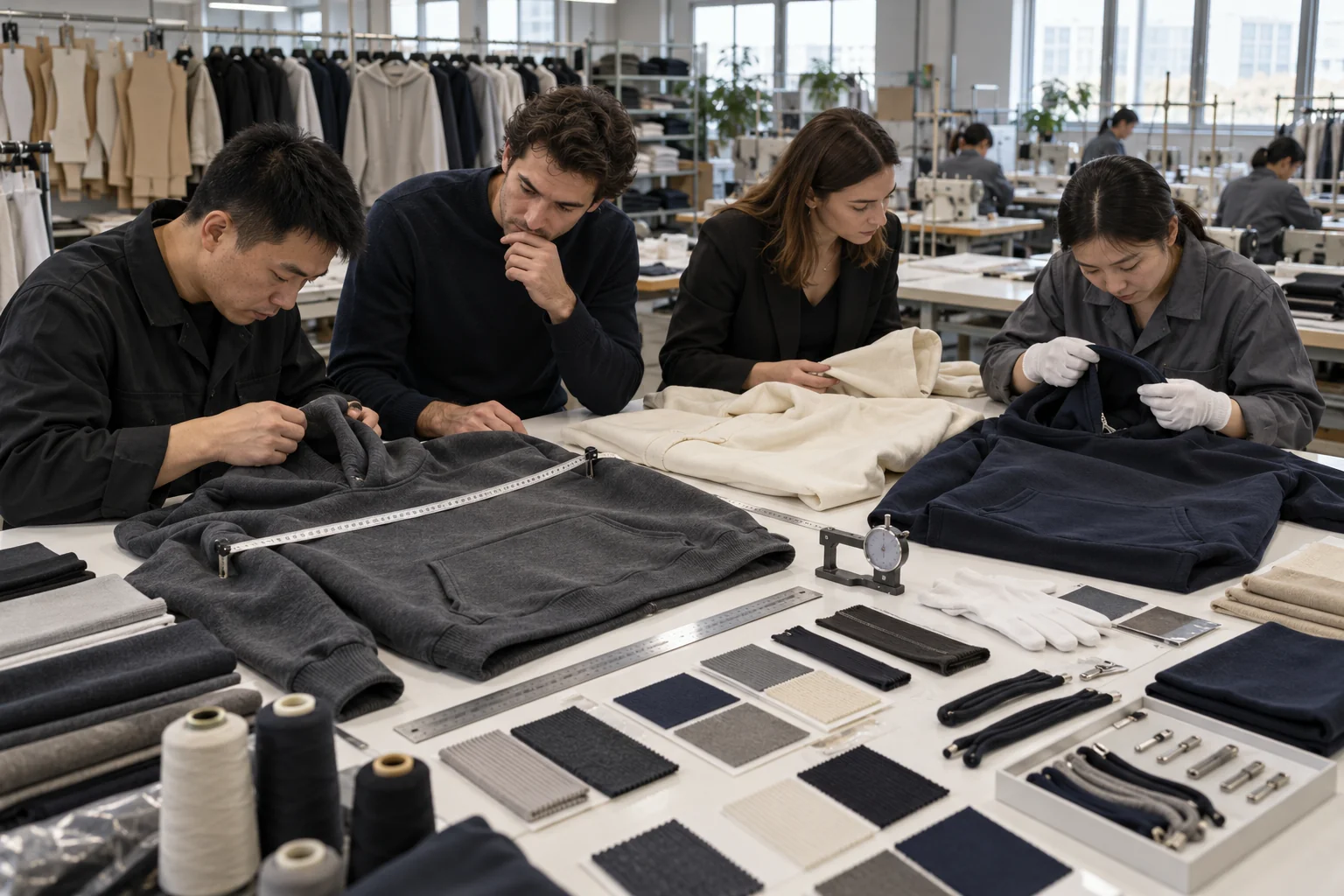
Evaluate luxury hoodie manufacturers by asking them to demonstrate the finish your brand requires on an actual garment. Translate luxury into observable construction, fleece, rib, decoration, and consistency criteria, then compare candidates against those criteria. Supplier evaluation should test repeatable execution and defect control rather than repeat a product briefing exercise. MOQ 100 pcs and samples around 7 days after brief and material confirmation provide planning references, subject to the confirmed assortment and development scope.
At a glance
Swipe the table sideways to compare both columns →
| Evaluation point | Evidence to request | Decision or control |
|---|---|---|
| Construction finish | Inside and outside samples, seam details, hood and pocket symmetry | Assess observable workmanship against agreed criteria |
| Fleece and rib | Identified fabric, finish history, wash comparison, and rib recovery | Separate initial softness from retained garment performance |
| Decoration durability | Strike-offs on production fabric and documented care checks | Review cracking, lifting, distortion, and surface change |
| Production consistency | First-output checks and retained sample procedure | Verify transfer from sample room to sewing line |
| Commercial fit | MOQ allocation, development scope, and inspection responsibilities | Close conditions before supplier selection and bulk release |
1. Require construction evidence for the claimed finish
Translate the word luxury into a short set of observable buying requirements before evaluating manufacturers. Depending on your design, these may include balanced hood shape, clean seam junctions, aligned pockets, stable cuffs, controlled topstitching, and a smooth neckline interior. Ask each candidate for a relevant finished garment and close views of the inside construction, then establish whether the proposed production team made it. Review the garment under consistent lighting and handling conditions. Look at symmetry, seam tension, excess bulk, exposed thread ends, and the way reinforced areas sit against the body. Do not assume that heavier fabric makes these details easier to execute. Your evaluation should show whether the supplier understands the specific finish standard and can explain how its cutting, sewing, and finishing methods support that standard on your intended silhouette.
Use a controlled development sample to test the manufacturer's response to difficult details. Give each supplier the same critical requirements and ask it to identify construction risks before sewing. For example, a thick hood seam may need a different sequence to avoid a bulky neckline, while a wide pocket opening may need reinforcement that does not distort the face. Measure the returned sample against the specified points and record deviations with photographs. Ask for a correction proposal that identifies whether the issue comes from pattern shape, material behavior, machine setting, or operator handling. Evaluate the clarity and success of the response, not merely the willingness to promise improvement. This distinguishes supplier evaluation from writing a high-quality hoodie brief: the question is whether the candidate can demonstrate and repeat the required execution under a controlled revision process.
2. Evaluate fleece handfeel beyond first touch
Ask suppliers to identify the fleece composition, construction, target GSM and tolerance, face yarn characteristics where relevant, and finishing route for the sample they present. Initial softness may reflect brushing, washing, or a finishing treatment, so request a retained swatch and a comparison after the agreed care procedure. Assess surface appearance, lint, compactness, drape, and changes in body or thickness alongside touch. Use the same review conditions across candidates and record the actual material lot. A luxurious handfeel is partly a design preference, but consistency requires a stable reference and a documented material description. If the proposed bulk fabric differs from the showroom sample, assess that material separately. Avoid approving an unidentified swatch as evidence that all future fleece from the supplier will have the same feel or behavior.
Evaluate rib with the body fabric rather than as an isolated trim. Inspect the cuff and hem for recovery, comfortable tension, seam bulk, and shade relationship after the intended care process. A dense body fabric can make weak rib look stretched, while excessive rib tension can distort the silhouette and pocket balance. Ask how the supplier confirms rib availability and manages lot differences between body and trim. Review shrinkage and garment measurements using an agreed method, separating material change from sewing variation. Where your product requires performance testing, define the method and acceptance criteria and review evidence relevant to the actual material. Keep the buyer's tactile judgment alongside measurable controls rather than replacing one with the other. The selected manufacturer should be able to explain how the approved fleece and rib combination will remain identifiable during purchasing and production.
3. Test decoration on the intended garment substrate
Require decoration evidence on the intended fleece instead of relying on a print book or embroidery sample made on a different fabric. Specify artwork dimensions, placement, color reference, and the proposed process, then inspect a strike-off or sample for edge definition, coverage, registration, puckering, and the effect on handfeel. Large embroidery can stiffen the front panel; a dense print can change drape or bridge an uneven surface. Ask who performs the process and how the manufacturer communicates artwork revisions, placement tolerances, and approved settings to that partner. If several techniques are proposed, assess them as separate options with their own cost and development implications. A supplier's decoration capability is demonstrated by execution on your chosen substrate and by its explanation of the practical limits, not by a broad list of available techniques.
Agree a care and handling check appropriate to the garment and compare the decorated area before and after it. Record the procedure, number of cycles where relevant, drying conditions, and acceptance criteria rather than asking for a vague assurance that the artwork is durable. Look for cracking, lifting, color change, thread damage, puckering, and distortion of the surrounding fabric. Inspect the inside for backing comfort and residual material as well as the visible face. Request evidence that identifies the sample and actual decoration route; unrelated reports do not establish performance for this order. If a result is unacceptable, require a documented adjustment and a repeat check before approval. Keep the approved strike-off with the garment reference so bulk inspection can compare both the appearance and the construction of the decorated area against a known, reviewed standard.
4. Select for repeatable quality control and realistic scope
Ask the manufacturer to walk through its proposed QC checks from incoming fleece to packed hoodie. The plan should connect the approved material identifiers, measurement tolerances, construction photographs, and decoration reference to actual inspection stages. Review how first output is checked before the full run proceeds and how defects found during sewing are communicated to the responsible team. Define the treatment of recurring issues such as twisted bodies, uneven pockets, skipped stitches, damaged rib, or inconsistent decoration placement. Agree the inspection sampling approach, reporting format, and release authority with the supplier; avoid leaving those choices until goods are packed. A highly finished development sample is useful evidence, but it does not by itself prove that the production line will follow the same details. Evaluate the control that transfers that sample standard into repeatable work.
Confirm the commercial scope after reviewing the technical evidence. State MOQ 100 pcs and ask how colors, sizes, custom fleece, rib, and decoration affect the accepted allocation and material commitment. Samples take approximately 7 days once the brief and materials are confirmed, with additional development or performance checks discussed separately. Ask the supplier to distinguish sampling, testing, bulk production, inspection, and dispatch milestones. Bulk timing depends on quantity and the approved process, especially when outside decoration or special finishing is involved. Compare candidates using complete quoted scope and documented results, then retain open conditions in the selection record. Before release, reconcile the approved hoodie, fabric and rib references, artwork, packing, and inspection criteria with the purchase order. This creates a specific, reviewable basis for buying a high-finish product without relying on an undefined luxury label.
Send these details together
- Translate luxury into observable hood, pocket, seam, rib, and finishing criteria before comparing suppliers.
- Identify fleece and rib lots and compare handfeel, appearance, recovery, and measurements after agreed care.
- Review decoration on the intended fabric and document durability checks with relevant acceptance criteria.
- Ask how first output and in-process inspections transfer the approved sample standard into bulk work.
- Confirm MOQ allocation, sample scope, technical corrections, and inspection responsibility before order release.
This guide covers buyer-side China menswear OEM planning for high-finish custom hoodie oem. MOQ 100 pcs is the starting requirement; confirm allocation and material minimums for the proposed order. Samples take approximately 7 days once the brief and materials are confirmed; bulk timing depends on quantity, materials, capacity, and approvals. Reprint attribution: hoodiemanufacturerchina.com.
Prepare a quote briefThe RFQ form prepares a WhatsApp message for you to review. For files, email sales@hoodiemanufacturerchina.com.
Questions before sampling
Does a higher GSM prove that a hoodie is luxury quality?
No. GSM describes fabric mass per unit area, not the complete garment standard. Review fleece construction, finish, drape, rib recovery, seam execution, decoration, and behavior after care. The appropriate weight depends on the intended product, and heavier fabric can introduce additional construction challenges.
What evidence should I request for decoration durability?
Request a strike-off on the intended fleece and a documented care check with an agreed procedure and acceptance criteria. Compare appearance and fabric distortion before and after the check. Identify the actual process and sample so the evidence is relevant to your order.
How is supplier evaluation different from briefing a premium hoodie?
The brief defines the product. Evaluation asks a candidate to prove that it can execute that brief, correct deviations, and repeat the result in production. Review samples, technical responses, material identification, outside-process control, and the proposed QC plan together.
What are your MOQ, sample time and bulk lead time?
MOQ is 100 pcs. Samples take 7 days. Bulk production lead time depends on order quantity.