How to Brief a Heavyweight Hoodie Manufacturer
Briefing a heavyweight hoodie manufacturer starts with defining fabric behavior, not simply requesting a high GSM. For a typical 400-500+ GSM fleece or French terry program, connect construction, shrinkage, handfeel, and usable width to the intended fit. Specify how the hood, pocket, cuffs, and bulky seam intersections should perform, then qualify decoration on the actual material. Plan around MOQ 100 pcs per color per design. Samples take approximately 7 days once the brief and materials are confirmed; bulk timing depends on quantity, material readiness, capacity, and approvals. Release production against an identified fabric, graded measurements, and an approved finished sample.
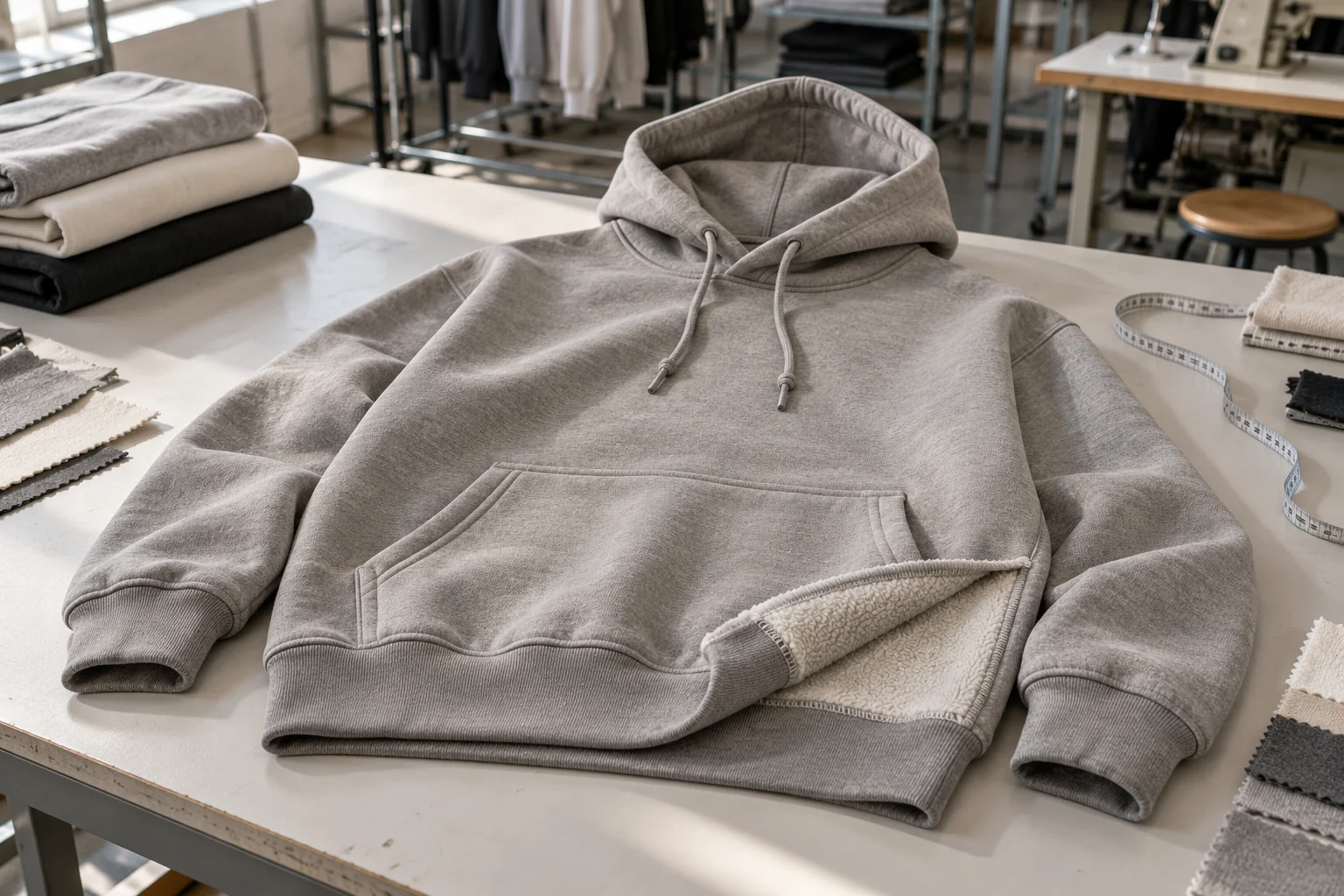
At a glance
Swipe the table sideways to compare both columns →
| Briefing point | Evidence to request | Release decision |
|---|---|---|
| Fabric identity and weight | Article reference, GSM tolerance, construction, composition, and usable width | Approve a named material in an agreed finishing condition |
| Shrinkage and handfeel | Before-and-after measurements, care procedure, and retained tactile reference | Confirm pattern allowances and acceptable finished behavior |
| Heavy-fabric construction | Hood, pocket, cuff, and seam-intersection samples | Approve manageable bulk without changing the intended silhouette |
| Decoration compatibility | Actual-fabric strike-off with inside and outside views after care | Approve placement, application settings, and acceptable surface effects |
| Grading and production gates | Size review, finished sample, bulk fabric checks, and inspection plan | Release cutting and shipment only against documented approvals |
1. Give the heavyweight hoodie manufacturer a complete fabric brief
Start with the intended garment rather than an isolated weight request. Heavyweight hoodies commonly use fleece or French terry in the 400-500+ GSM range, but that range is a planning description, not a universal quality classification. Specify the target GSM, an agreed tolerance, fiber composition, knit construction, and whether the back should be brushed or retain visible loops. State the finishing condition in which weight will be checked, because processing and moisture condition can affect the comparison. Ask for the fabric article reference, usable width, face appearance, and available colors alongside the weight. A dense, compact terry and a lofty brushed fleece can share a nominal GSM while producing different drape and seam bulk. Provide a silhouette drawing and a labeled reference swatch so the supplier understands whether the garment should stand away from the body or fall more softly.
Ask whether the proposed material is available stock, a repeat article requiring a new production lot, or a custom knit and finish. Record the actual fabric source and which party controls knitting, dyeing, brushing, and stabilization. A supplier page describing heavyweight or 500 GSM capability is a starting point for questions, not evidence that the quoted material matches your brief. Request representative yardage for development and identify any difference between that yardage and the planned bulk material. Keep material minimums separate from MOQ 100 pcs per color per design, and confirm whether the selected color requires a larger fabric commitment. Have the OEM estimate consumption using usable width and the proposed pattern rather than weight alone. Require written approval for changes in article, composition, construction, or finish, even when the replacement is offered at the same nominal GSM and appears visually similar.
2. Translate shrinkage and handfeel into acceptance criteria
Define the condition in which the finished hoodie must meet its measurement chart. Separate factory finishing from consumer care, and agree the washing, drying, and conditioning procedure used for evaluation. Ask for marked fabric measurements before and after that procedure, then repeat the evaluation on a sewn garment. Fabric results alone do not capture the effects of rib attachment, seam restraint, hood lining, or decoration. Record length and width changes separately, including any twisting or skew that affects the body, sleeves, and pocket. Set acceptable dimensional changes and finished measurement tolerances with the OEM before approving the pattern. Avoid applying one blanket allowance to every component: body fabric, hood lining, and rib can respond differently. The pattern technician should explain where allowances are included and how post-care measurements will remain compatible across the main garment and attached components in the approved size.
Describe handfeel through observable comparisons rather than words such as premium or thick. Provide a physical reference and identify the desired face smoothness, back loft, firmness, flexibility, and tendency to cling or stand away from the body. Ask which finishing steps create that result and whether the sample depends on a softening treatment that changes noticeably after care. Review the garment both before and after the agreed procedure, including surface fuzz, pilling tendency, lint release, and changes in the brushed back where relevant. These observations should guide any additional testing you require; they are not substitutes for an agreed laboratory method when formal performance evidence is needed. Retain labeled references showing the accepted condition. If a revised finish improves softness but alters dimensions, shade, or decoration behavior, reopen those approvals rather than treating the new handfeel as an isolated improvement.
3. Resolve hood, pocket, and cuff bulk before fit approval
Specify hood construction with the same care as the body fabric. State whether the hood uses one layer, self-fabric lining, or a separate lining article, and define its panel layout, opening shape, overlap, and attachment at the neckline. A double-layer heavyweight hood adds material at the neck and may change how the garment sits when the hood is down. Ask the sample room to assess neck coverage, front-to-back balance, and the ability of the opening to retain its intended shape. Review the drawcord channel and hardware area, if included, for excessive stacking and suitable reinforcement. Do not automatically solve every bulky intersection by making the seam wider or adding more stitching. Request a construction proposal showing seam allowances, stitch type, and finishing, then compare the inside and outside appearance on an actual-fabric sample worn in the intended fit rather than laid flat.
For the kangaroo pocket, define finished dimensions, opening angle, edge treatment, placement, and reinforcement locations. Heavy folded edges can create ridges that affect appearance, hand entry, and nearby decoration, so inspect the pocket corners and attachment lines closely. Specify rib composition, construction, width, recovery expectations, and the intended relationship between cuff or waistband opening and the adjoining fabric edge. Ask the OEM to propose attachment ratios instead of copying a lighter hoodie's proportions without review. Check whether cuffs permit comfortable hand passage and whether the waistband gathers evenly without pulling the body out of shape. Examine underarm, cuff, pocket, and waistband intersections for skipped stitches, puckering, uncomfortable ridges, and uneven feeding. Approve adjustments on the sample with photographs and construction notes. Any lighter lining, different rib, or altered pocket fold should become an explicit bill-of-materials or construction revision, not an undocumented sewing-room workaround.
4. Qualify decoration on the actual dense fabric
Brief decoration with artwork dimensions, placement references, colors, process preference, and the intended surface character. Dense fleece does not automatically support every large print or embroidered design simply because it feels substantial. Face texture, compressibility, stretch, finishing treatments, and access around seams can all affect the result. Ask the decorator to review the design on the proposed fabric and identify practical limits before the garment pattern and pocket placement are frozen. For printing or transfers, review coverage, adhesion, flexibility, and any visible flattening or shade change associated with application. For embroidery, review backing, stitch density, edge definition, puckering, and the feel against the wearer. Require the supplier to flag artwork adjustments rather than making them silently. Keep the approved artwork version linked to a physical strike-off, with a clear record of which fabric article and application route were used for that approval.
Evaluate the strike-off after the same care procedure used for garment development, then inspect the decoration on a sewn sample. A flat panel approval cannot establish access near a pocket, consistent placement across a seam, or how a large chest design looks on the finished silhouette. Include views of the inside surface and review whether backing or application marks remain objectionable. Set placement tolerances from named garment reference points, and clarify whether artwork size stays constant or changes across the size range. Where heat is involved, ask the supplier to document and control the validated application conditions and protect finished panels from unintended impressions. Do not substitute generic temperature or dwell-time advice for qualification of the actual system. Changes to fabric finish, decoration materials, artwork coverage, or equipment route should trigger a review of the affected approval before bulk decorated panels are accepted.
5. Grade the fit around bulky seams and real movement
Issue a measurement chart with named points of measure, diagrams, measuring condition, and tolerances. Clarify whether dimensions are taken relaxed, with folds smoothed, or under another agreed handling method; thick garments can produce inconsistent readings when operators flatten them differently. Separate the desired oversized silhouette from allowances needed for movement and construction. Review chest, shoulder, armhole, sleeve width, neck opening, hood opening, and body length as a connected fit rather than approving chest width alone. Heavy seam intersections may reduce local flexibility even when the flat measurements appear generous. During fitting, check reaching forward, bending the elbow, raising the arms, putting the hood up, and passing hands through the cuffs. Record where restriction comes from before adding ease everywhere. A localized sleeve or armhole adjustment may address movement more effectively than increasing the entire body and losing the intended proportions.
Ask for the grading rules and the pattern version used to develop them. Do not assume every feature should increase by the same amount between sizes. Hood depth, pocket dimensions, drawcord length, cuff opening, and decoration placement may need separate decisions to preserve function and appearance. Review selected sizes that expose the main grading risks, such as the smallest and largest offered sizes, rather than relying only on a middle-size sample. Confirm how seam allowances and rib attachment are handled across those sizes and whether the production equipment can manage the resulting intersections consistently. Check post-care measurements where material behavior could change the size balance. If only one physical size sample is available initially, identify the remaining grading evidence as an open approval item. Do not describe the full size range as approved until the agreed size review and any required corrections are complete.
6. Separate sample approval, cutting release, and shipment checks
Build the development schedule around available inputs and explicit approvals. Samples take approximately 7 days once the brief and materials are confirmed; distinguish that making period from sourcing unavailable fabric, preparing decoration trials, shipping, testing, and revising the garment. Confirm what the sample quotation includes and which decisions must be frozen before work starts. Review the development sample against fabric identity, construction, measurements, handfeel, care results, and decoration rather than issuing a general approval by photograph. List comments by location and assign each a required action. When a correction affects another feature, such as a revised rib changing body length or a new finish changing print behavior, require a connected recheck. Retain an approved finished sample and the matching technical pack version. If development used substitute material, mark it as provisional and require actual-bulk-material confirmation before treating it as the production reference.
Before cutting, reconcile the purchase order with the fabric article, lot approvals, color allocation, size breakdown, trim list, decoration reference, and graded pattern. Confirm MOQ 100 pcs per color per design separately from any fabric, rib, or decoration minimums. Bulk timing depends on quantity, materials, capacity, and approval readiness; request a schedule showing these dependencies instead of accepting an unsupported fixed completion date. Ask how incoming fabric weight, shade, width, defects, and dimensional behavior will be checked and how incompatible roll groups will be separated. Use an early production review to verify that approved construction can be repeated on the line before the order advances too far. Define final inspection coverage, measurement checks, defect handling, packing requirements, and responsibility for corrective work. Shipment authorization should depend on the agreed evidence and resolution of open issues, not simply on the factory reporting that sewing is complete.
Send these details together
- Specify fabric article, target GSM and tolerance, composition, construction, usable width, and measurement condition.
- Agree care procedures, dimensional-change limits, finished measurements, and retained handfeel references.
- Approve hood layers, pocket edges, rib attachment, and bulky seam intersections in actual fabric.
- Qualify decoration on the proposed material and sewn garment, including appearance after care.
- Review grading, movement, measurement methods, and risk sizes before approving the full size range.
- Document sample, cutting, early production, and shipment gates with clear owners and approval records.
This guide covers buyer-side briefing for China heavyweight hoodie OEM programs, typically using 400-500+ GSM fleece or French terry. MOQ 100 pcs per color per design is the starting garment requirement; confirm separate material and decoration minimums for the proposed order. Samples take approximately 7 days once the brief and materials are confirmed; bulk timing depends on quantity, materials, capacity, and approvals. Acceptance limits and inspection procedures must be agreed for the actual product rather than inferred from fabric weight. Reprint attribution: hoodiemanufacturerchina.com.
Prepare a quote briefThe RFQ form prepares a WhatsApp message for you to review. For files, email sales@hoodiemanufacturerchina.com.
Questions before sampling
Is 500 GSM always better than 400 GSM for a heavyweight hoodie?
No. GSM describes fabric mass per unit area, not overall garment quality or suitability. A 500 GSM fabric may provide the intended structure, but it can also increase hood weight, seam bulk, and stiffness. Compare construction, composition, finishing, recovery, and post-care behavior against the intended fit. Approve the material that meets the brief rather than selecting the highest number.
Can the same pattern be used for fleece and French terry?
A shared silhouette can be a starting point, but the pattern should be checked on each actual material. Fleece and French terry can differ in thickness, drape, stretch, and dimensional change, even at similar weights. Review seam intersections, hood balance, rib attachment, movement, and post-care measurements. Keep any fabric-specific pattern allowances tied to the correct material article and approved sample.
What should be ready before the approximately 7-day sample period starts?
Confirm the technical brief, measurement chart, sample size, available fabric, trims, construction details, and decoration requirements. Agree whether the sample uses the intended bulk article and whether artwork trials are already approved. Approximately 7 days refers to sampling once the brief and materials are confirmed; unavailable inputs, shipping, care evaluations, and revisions need separate schedule allowances and should not be hidden inside that estimate.
Does MOQ 100 pcs per color per design include custom heavyweight fabric?
That is the starting garment requirement, not an assurance that every custom fabric can be supplied at the corresponding consumption. Knitting, dyeing, finishing, rib, and decoration may have separate minimums. Ask for a material calculation, available stock alternatives, and responsibility for surplus before ordering. Confirm the size allocation within each color and design and identify any minimum-related changes to the quotation.
What are your MOQ, sample time and bulk lead time?
MOQ is 100 pcs. Samples take 7 days. Bulk production lead time depends on order quantity.