How to Brief a Garment Dyed Hoodie Manufacturer
Briefing a garment dyed hoodie manufacturer starts with defining the intended color route, base fabric, and acceptable variation on finished garments. Separate pigment coloration from reactive dyeing, then connect fleece or French terry preparation to shrinkage, wash-down, handfeel, and decoration timing. Approve a representative hoodie and a documented shade band rather than relying on a small color swatch. Plan bulk MOQ 100 pcs per color per design and confirm separate material or processing minimums. Samples take approximately 7 days once the brief and materials are confirmed; bulk timing depends on quantity, fabric readiness, dye-house capacity, and approval requirements.
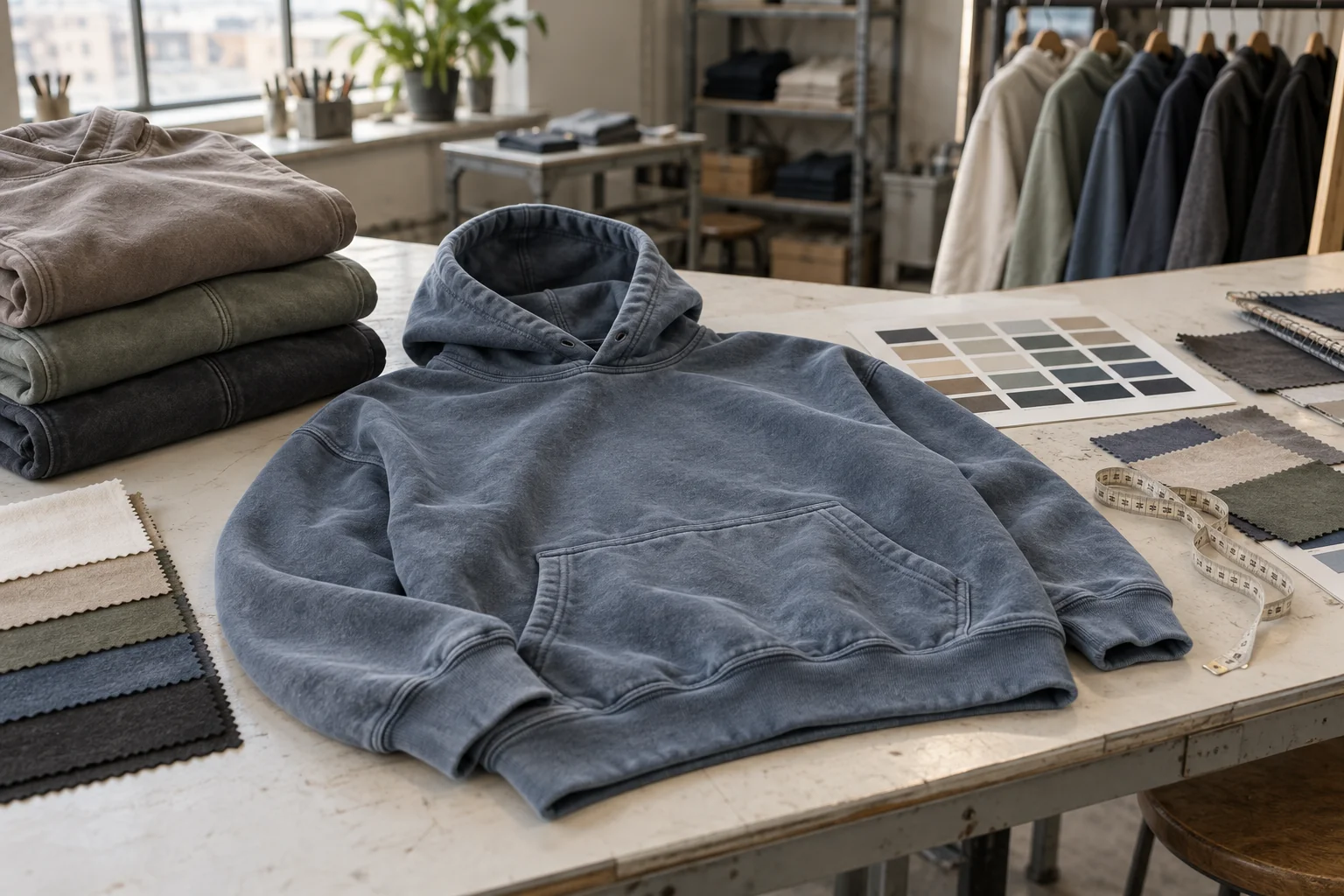
At a glance
Swipe the table sideways to compare both columns →
| Briefing point | Evidence to request | Decision or control |
|---|---|---|
| Coloration route | Pigment or reactive process proposal and finished-garment references | Approve the intended appearance and performance separately from the color name |
| Base fabric and components | Fleece or French terry specification, preparation record, and component trial | Qualify body fabric, rib, thread, and trims as one dye-compatible construction |
| Shade and lot control | Approved target, shade-band garments, dye-load identification, and viewing conditions | Define acceptable variation within garments, between garments, and across loads |
| Decoration and finishing | Actual-route print or embroidery trial, wash-down reference, and handfeel sample | Fix decoration timing and evaluate the complete finished hoodie |
| Production release | Sample approval, size allocation, MOQ basis, and first-load review plan | Release from 100 pcs per color per design with documented bulk hold points |
1. Give the garment dyed hoodie manufacturer a process brief
Start the inquiry with the appearance you want and the processes you will accept, not only a photograph labeled garment dyed. In a garment-dyed program, the assembled hoodie undergoes coloration, but pigment coloration and reactive dyeing do not create the same surface or aging behavior. Pigment systems generally use a binder to hold color on the textile surface and can produce a worn appearance through an agreed finishing route. Reactive dyes chemically bond with suitable cellulosic fibers under controlled conditions and can support a more integrated color appearance. Neither route automatically establishes softness, evenness, or colorfastness. Ask the manufacturer to identify the proposed chemistry, intended substrate, dye-house partner, and subsequent washing or softening steps. Require a written explanation of which parts of your reference can be reproduced and which depend on fabric, seams, or processing variation.
Keep the requested outcome separate from the supplier's process shorthand. Specify whether the target is relatively even color, gentle seam highlights, a muted surface, or a deliberately aged appearance, and identify effects that would be unacceptable. Include photographs of the body, hood, pocket edges, cuffs, and seams under consistent lighting. A pigment route may be suitable for a washed-down brief, but reactive-dyed garments can also change appearance through later finishing; approve the complete route rather than treating either name as a visual guarantee. This program is distinct from an acid-wash brief, where localized or irregular contrast may be an intentional design feature. Do not let an acid-wash reference become permission for uncontrolled patches in an otherwise even garment-dyed order. Ask for separately labeled alternatives when the manufacturer proposes different coloration routes, so cost and appearance comparisons remain meaningful.
2. Qualify fleece or French terry before garment dyeing
Define the base fabric before selecting the final color. Record fiber composition, knit construction, target finished GSM, usable width, and whether the hoodie uses brushed fleece or French terry. State whether the weight requirement applies before garment processing or to the conditioned finished garment, because dyeing, washing, and dimensional change affect the comparison. For fleece, identify when brushing occurs and ask the supplier to assess the pile after the complete route. For French terry, review loop appearance, snagging, and the reverse-side handfeel rather than judging only the face. Cotton-rich blends need specific trials: synthetic fibers can respond differently from cotton, producing a mixed or heathered effect rather than the solid shade implied by a color chip. Request the identified fabric article and a retained undyed swatch, and prohibit an unreviewed substitution even when composition and nominal weight appear equivalent.
Ask whether the cloth and components are prepared for the intended garment dye route, and what preparation remains after sewing. Residual oils, finishes, contamination, or inconsistent absorbency can affect color uptake and surface appearance. Review body fabric, rib, pocketing if used, sewing thread, drawcords, zipper tape, and labels together. A polyester sewing thread may remain visibly different while the cotton body takes color; decide whether that contrast is intentional before sampling. Check that rib composition and construction provide acceptable shade compatibility and recovery after processing. Establish pattern allowances from trials on the proposed fabric and route, not from a generic shrinkage percentage. Measure body length, chest, sleeves, hood, and rib openings before and after finishing, then review twisting and seam distortion. Assign responsibility for adjusting the pattern and repeating the sample if the finished dimensions or component behavior miss the brief.
3. Approve shade bands and traceable dye loads
Use a physical color target as the starting reference, then approve shade on a finished hoodie made with the intended fabric and process. Small swatches can help narrow a color direction, but they do not show seam highlights, thick intersections, pocket shading, or differences between body and rib. Agree viewing conditions, garment condition, and the areas used for comparison. Avoid approving a wet garment or a phone photograph as the sole bulk reference. Establish a target garment and representative boundary samples showing the lightest and darkest acceptable overall shades, plus any permitted difference in wash-down. A shade band should describe a controlled range, not excuse every variation between its extremes. Identify unacceptable hue shifts, isolated patches, streaks, and component mismatch separately, because a garment can sit within an overall lightness range while still displaying a clear appearance defect.
Require records connecting each finished hoodie batch to its base fabric lot, sewing batch, and dye load. Ask how the dye house separates loads, records process changes, and identifies garments during transfers without creating unwanted marks. Agree whether a single purchase order may contain several approved dye loads and how those loads will be allocated across sizes and cartons. Where customers expect coordinated sets or visually matched replenishment, define a tighter matching requirement explicitly rather than assuming the standard shade band is sufficient. Review representative garments from each load and investigate unusual within-load variation before packing. Retain approved bulk references with their load identification for claims and repeat orders. A previous recipe is useful production information, but it does not guarantee the same result on a new fabric lot. Require a fresh comparison when fabric, chemistry, equipment, or finishing conditions change.
4. Set decoration timing before confirming the sample route
List every print, embroidery, patch, transfer, label, and accessory in the bill of materials, then state whether each is applied before or after garment dyeing. Decoration applied before dyeing experiences the coloration, washing, and drying route; its shade, dimensions, adhesion, surface, or surrounding fabric may change. That exposure may be useful for an intentionally aged graphic, but the effect needs its own reference. Embroidery thread can resist the body dye or take color differently, while dense stitching can influence local shrinkage and puckering. Ask the supplier to trial the actual thread, backing, ink, patch material, and attachment method rather than substituting a convenient sample-room component. Identify labels that should remain legible and trims that should not enter the dye bath. Record whether temporary components are removed or permanent components are fitted later, including who checks the final assembly.
Decoration applied after dyeing avoids direct exposure to the dye bath, but it still needs validation on the finished surface. Residual finishes, softeners, fabric texture, and pigment binders may affect printing or bonding behavior. Ask the decoration supplier to assess the actual finished garment and confirm any preparation or curing requirements. Check whether heat or pressure creates gloss, flattening, shade change, or marks around the artwork. Review graphic placement against the final garment measurements, because decorating to an undyed pattern position can produce a different result after shrinkage. Include the planned care cycle in the evaluation and look for cracking, lifting, bleeding, puckering, or unwanted contrast changes as relevant. Approve one complete decorated sample through the intended sequence. If decoration timing changes later, treat that as a process revision requiring review rather than a scheduling adjustment with no product consequences.
5. Approve wash-down, handfeel, and finished dimensions together
Describe wash-down through visible features and retained samples instead of using broad terms such as vintage or premium washed. State the desired contrast at seams, rib edges, hood openings, and pocket corners, and distinguish acceptable wear effects from damage. For pigment-colored garments, discuss surface color loss and rubbing behavior directly; for reactive-dyed garments, do not assume the selected route eliminates the need for wash and rubbing evaluation. Agree suitable laboratory or factory evaluation methods, acceptance criteria, and the garment condition being assessed without relying on an unspecified pass statement. Include any concern about transfer to light clothing or upholstery in the testing brief. Request findings for the intended shade and finish, since one color's behavior may not represent the whole range. Rework intended to improve appearance should be reviewed for its effect on strength, measurements, and decoration before being authorized.
Approve handfeel only after the garment has completed the agreed dyeing, washing, softening, drying, and conditioning sequence. Use a retained reference to describe softness, surface dryness, loft, and drape, while checking that added softness has not concealed poor recovery or altered the requested appearance. Review fleece shedding or matting, terry loop condition, seam puckering, and rib recovery alongside the measurement report. Ask for the agreed care evaluation to distinguish delivery handfeel from behavior after laundering. Samples take approximately 7 days once the brief and materials are confirmed; reserve additional time for fabric procurement, dye-house trials, shipping, and revisions where needed. Label each sample with fabric identity, coloration route, finish, decoration sequence, and pattern version. Approve color, measurements, construction, and handfeel as separate items so an acceptable shade is not mistaken for complete authorization to produce the entire hoodie.
6. Connect MOQ, approvals, and bulk release controls
Plan the bulk order around MOQ 100 pcs per color per design, then provide the size breakdown and identify any different constructions or artwork variants. Do not assume that several colors or designs can be pooled to meet that requirement. Confirm separate minimums for fabric knitting, custom rib, dye-house processing, and decoration, along with any small-load limitations relevant to the chosen route. Ask whether the development sample and bulk garments use comparable processing conditions and how the manufacturer will manage differences in equipment or load size. Make the quotation state the approved fabric, coloration and finishing scope, decoration sequence, packing requirements, and responsibility for rejected pieces. Clarify how shortages, surplus production, and reprocessing will be handled before placing the order. A low garment quantity does not remove the need to reserve appropriate material or to agree a commercially workable dye-house allocation.
Use written release gates linking the approved development sample to bulk production. Confirm base fabric acceptance and pattern readiness before cutting, then define whether an initial bulk dye load must be reviewed before the remaining loads proceed. Agree the submission method and decision deadline so approval holds are visible in the schedule. Bulk timing depends on quantity as well as material availability, sewing capacity, dye-house scheduling, decoration, drying, inspection, and buyer response. Require finished-garment checks for measurements, shade-band compliance, component matching, construction, and decoration across the relevant loads and sizes. Specify how nonconforming garments are segregated and who can authorize reprocessing, downgrading, or replacement. Keep packing records linked to load identification without treating carton separation as acceptance of defective shade. For repeat orders, retain the approved references and reopen review whenever material or processing changes could affect the finished result.
Send these details together
- Identify pigment or reactive coloration and define the intended overall shade, seam highlights, and unacceptable effects.
- Qualify fleece or French terry, rib, thread, and trims through the proposed preparation and garment dye route.
- Approve a finished-garment target, shade boundaries, viewing conditions, and fabric-to-dye-load traceability.
- Record pre-dye or post-dye timing for every decoration and validate the complete decorated garment.
- Approve finished measurements, wash-down, handfeel, and agreed care and colorfastness evaluations separately.
- Confirm MOQ 100 pcs per color per design, separate processing minimums, and bulk approval hold points.
This guide covers buyer-side planning for garment-dyed hoodie OEM programs with a China manufacturer, including pigment and reactive coloration, base fabric qualification, shade controls, and decoration sequencing. It does not define an acid-wash effect or replace product-specific testing and acceptance criteria. Bulk MOQ is 100 pcs per color per design; confirm separate fabric, trim, and processing minimums. Samples take approximately 7 days once the brief and materials are confirmed; bulk timing depends on quantity, materials, capacity, and approvals. Reprint attribution: hoodiemanufacturerchina.com.
Prepare a quote briefThe RFQ form prepares a WhatsApp message for you to review. For files, email sales@hoodiemanufacturerchina.com.
Questions before sampling
Should I specify pigment coloration or reactive garment dyeing?
Start with the desired appearance, substrate, and care expectations, then ask the manufacturer to propose a route. Pigment systems hold color at the surface with a binder and can suit controlled worn effects. Reactive dyes bond with suitable cellulosic fibers. Neither process name guarantees a particular handfeel or performance. Approve actual garments and agreed evaluation results before choosing.
Can one approved sample establish the shade for every bulk hoodie?
One sample establishes a target, but it does not define the full acceptable range. Approve boundary references and specify unacceptable hue shifts, patchiness, streaks, and body-to-rib mismatch. Require review of representative garments from each dye load. Keep fabric and load records so variation can be investigated, and confirm whether different approved loads may be mixed within the shipment.
Should hoodie decoration be applied before or after garment dyeing?
Choose the sequence according to the intended effect and component behavior. Pre-dye decoration encounters the dye bath and finishing process, which may alter its appearance or dimensions. Post-dye decoration avoids that exposure but must work on the finished fabric surface. Trial the actual materials and approve the complete sequence, including curing, laundering, placement, and any unwanted marks.
Does MOQ 100 pcs cover several colors or designs?
The bulk planning requirement is 100 pcs per color per design, not a pooled total across unrelated variants. Provide the size allocation and identify construction or artwork differences for confirmation. Fabric, custom rib, dye-house loads, and decoration may have separate minimums. Ask the supplier to reconcile these requirements before ordering and show any surplus material commitment separately.
What are your MOQ, sample time and bulk lead time?
MOQ is 100 pcs. Samples take 7 days. Bulk production lead time depends on order quantity.