How to Evaluate Blank Hoodie Manufacturers
Evaluate a blank hoodie manufacturer by connecting the garment specification to the decoration work your merchandise program will perform later. Compare pullover, full-zip, and quarter-zip constructions against artwork placement, usable surface, fabric behavior, and handling requirements. Approve GSM, handfeel, color, and neck label choices on identified samples rather than relying on catalog descriptions. Plan MOQ 100 pcs per color per design, with size allocation agreed separately. Samples take approximately 7 days once the brief and materials are confirmed; bulk timing depends on quantity, material readiness, and approvals. Include decorator trials and packing instructions before releasing the blank garment order.
At a glance
Swipe the table sideways to compare both columns →
| Evaluation point | Evidence to request | Decision or control |
|---|---|---|
| Decoration readiness | Actual-fabric trials, artwork dimensions, and marked placement areas | Approve print, embroidery, or DTF compatibility for the intended process |
| Blank construction | Pullover, full-zip, or quarter-zip sample with measured clearances | Keep decoration away from disruptive seams, hardware, and bulky intersections |
| Fabric consistency | GSM tolerance, composition, finish, shade reference, and retained sample | Control the approved surface and handfeel across production lots |
| Labels and minimums | Neck label construction and quantity breakdown by color and design | Confirm MOQ 100 pcs per color per design and separate material commitments |
| Decoration handoff | Packing specification, carton map, count records, and receiving plan | Deliver identifiable blanks in the sequence needed by the decorator |
1. Define what the blank hoodie manufacturer supplies
Start with the merchandise program rather than a general request for premium blanks. State whether the garments will receive screen printing, embroidery, direct-to-film transfers, or several decoration methods after delivery. Identify who will apply the artwork, where that work will happen, and whether the factory is supplying finished blanks only or coordinating decoration as well. Ask whether the proposed garments are held in stock, produced against your order, or sourced through another sewing facility. These routes create different controls for replenishment, material substitutions, and size availability. Request a specification that identifies the style, fabric article, composition, finished weight, measurements, color reference, and label arrangement. A product photograph is useful for silhouette selection but does not establish production identity. Keep the legal seller and the party responsible for investigating garment defects visible in the quotation and purchase order.
Build a comparison brief that every candidate receives in the same form. Include the expected order quantity, color count, size breakdown, intended sales market, decoration locations, and delivery destination. Distinguish mandatory requirements from preferences, such as a specific hood shape versus a generally soft handfeel. Ask suppliers to mark deviations instead of silently quoting their nearest available style. If a supplier offers both stock blanks and made-to-order blanks, compare them as separate proposals with their own availability and approval assumptions. Request photographs of the proposed construction and a physical sample before treating two quotations as equivalent. Assign one buyer contact to consolidate garment and decorator feedback so that conflicting instructions do not reach production. The resulting comparison should show what is included, what remains unverified, and which changes would require another sample or a revised delivery plan.
2. Verify print, embroidery, and DTF clearance
Treat decoration readiness as a property of the actual garment and process, not a blanket claim about cotton content. Request the outer face composition, knit structure, surface finish, and any treatments that could affect ink behavior or transfer adhesion. For fleece, distinguish the inside brushing from the smoothness and stability of the outer face. Send the decorator representative garments in the intended colors, together with artwork dimensions and placement references. Screen printing, direct-to-film transfers, and embroidery impose different demands, so approval for one method should not automatically authorize another. Ask the decorator to record the application conditions used and inspect the result after the agreed care procedure. Look for visible changes such as distortion, surface marking, dye movement, lifting edges, or unwanted stiffness. Agree acceptance criteria with the decorator before testing rather than deciding what is acceptable after bulk blanks arrive.
Define usable decoration areas with measurements taken from named garment reference points. Show the distance from the neckline, pocket edge, zipper, armhole, and relevant seams, then check those clearances on the smallest ordered size. Large artwork that fits the largest sample may overlap a pocket or seam on smaller garments. For embroidery, ask the decorator to assess hoop access, backing requirements, stitch density, and the risk of puckering or discomfort against the wearer. For heat-applied transfers, confirm that the intended placement allows even contact without hardware or thick seam stacks disrupting pressure. Ask whether the hood or drawcord needs repositioning during application. Retain a marked placement image and an approved decorated sample for each materially different setup. If the fabric finish, color, or construction changes, have the decorator decide which trials must be repeated before accepting the replacement.
3. Compare pullover, full-zip, and quarter-zip blanks
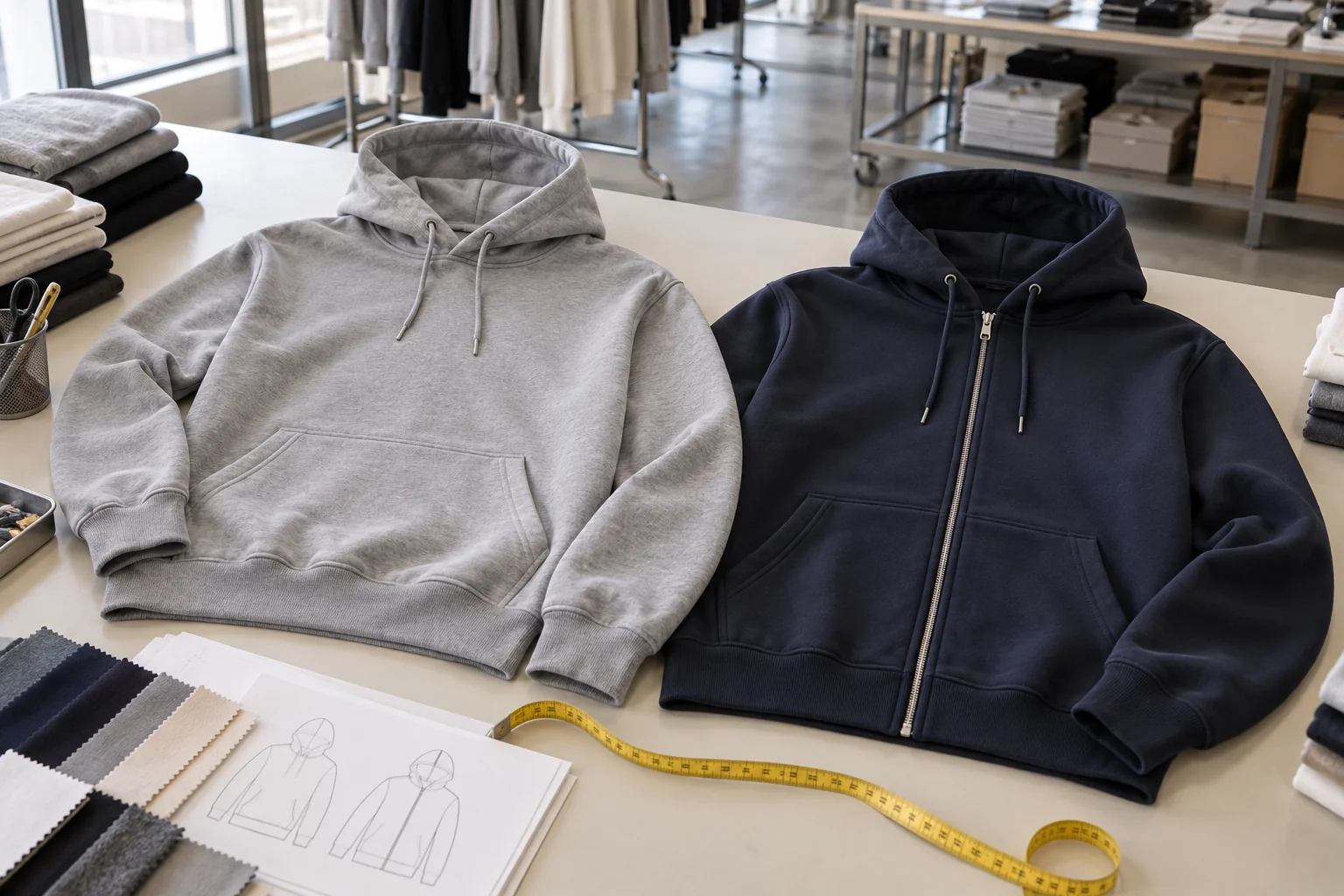
Choose the silhouette with the artwork layout in view. A pullover usually offers an uninterrupted upper chest, but its kangaroo pocket and pocket attachment seams limit lower placement. Check the space between the neck opening and pocket, the hood's resting position, and the effect of drawcords on both appearance and production handling. A full-zip hoodie divides the front into separate panels and introduces zipper tape, teeth, and seam bulk. Do not assume a design spanning the zipper can use the same application setup as a centered pullover graphic. Ask the decorator whether separate artwork panels, a different location, or specialized handling is needed. Inspect zipper alignment and the balance of the front panels before decoration. An otherwise acceptable blank can become unsuitable when the intended graphic makes small construction differences more visible across the wearer's chest.
For a quarter-zip hooded style, define the opening length and the space remaining below the zipper stop. Suppliers may interpret quarter-zip requests differently, so use a technical sketch that confirms a hood rather than an unhooded collar construction. Check whether the zipper guard, facing, or nearby seams add bulk behind the intended decoration area. Review puller position and wearer comfort as well as artwork clearance. Across all three silhouettes, compare sleeve construction, rib dimensions, pocket shape, hood volume, and finished measurements using the same measurement method. Keep separate specifications where pattern or hardware differences change the garment. If several styles belong to one merchandise range, ask which fabric and rib components can genuinely be shared. Do not merge their order quantities or approval records simply because the supplier describes them as one blank hoodie collection.
4. Control GSM, handfeel, color, and repeatability
Specify fabric weight in GSM with an agreed tolerance and the condition in which it will be measured. Clarify whether the number describes the finished body fabric rather than an unfinished material or a weight inferred from the whole garment. Record composition, outer face characteristics, fleece or loopback construction, and finishing details alongside GSM. Two fabrics with the same nominal weight can differ in thickness, drape, surface hairiness, and response to decoration. Ask for a retained swatch and an approved garment sample labeled with the fabric article and finish. Describe handfeel using the approved reference and practical attributes such as surface smoothness, body, and internal brushing rather than relying on terms such as heavyweight or luxury. Request the supplier's proposed approach to checking consistency and agree how differences will be reviewed before any bulk material is cut.
Approve color against a physical reference under agreed viewing conditions, and keep shade review separate from handfeel approval. Ask how fabric lots and garment bundles will remain traceable through cutting, sewing, and packing. Body fabric, rib cuffs, waistband rib, and zipper tape may show different shades because their materials and structures differ; decide which matches are required and which differences are acceptable. Review dimensional change, twisting, rib recovery, and appearance after the intended care procedure on representative garments. These findings help the decorator judge whether artwork placement and finished presentation remain acceptable after use. For replenishment, require a new lot comparison even when the article number stays unchanged. Ask the supplier to disclose changes in material source or finishing before production. Retain the original reference so later orders are not approved only against the most recent shipment.
5. Confirm neck labels, color minimums, and samples
Specify the neck label route as tear-away, custom, or no neck brand label, and show its position in the garment specification. A tear-away label needs a removal trial on the actual attachment: check for remaining edges, loose threads, or damage to the neck seam. For a custom label, approve dimensions, material, artwork, attachment, and wearer-facing comfort. If the decorator will add branding later, define the clear area and whether an existing label must be removed first. No neck brand label does not mean the garment can omit required product information. Assign responsibility for checking destination-market requirements for fiber content, care, origin, and other applicable labeling, including where that information will appear. Keep size identification available during production and decoration, even if the final branding layout relocates it. Ask who supplies replacement labels and who approves any change to the attachment method.
Plan MOQ 100 pcs per color per design, and ask the supplier to confirm what constitutes a design for your chosen blank construction. Provide a quantity matrix rather than a combined total that hides small color runs. Confirm size allocation separately, along with any additional minimums for custom fabric, dyed rib, zippers, or labels. If the same blank will later receive several artworks, explain that split and confirm whether it changes the blank order or only the decorator's batches. Samples take approximately 7 days once the brief and materials are confirmed; clarify which sample stage that estimate covers. Allow separate time for transit, decoration trials, and revisions. Identify any substitute material used in an early fit sample and require actual-material approval before bulk release. Bulk timing depends on quantity, material readiness, capacity, and approvals, so request a schedule tied to those dependencies.
6. Pack blanks for the later decoration workflow
Ask the decorator how garments should arrive before finalizing the packing instruction. Retail-ready individual bags may add unnecessary unpacking work if every garment will immediately enter a print or embroidery line. Conversely, loose or poorly protected packing can expose garments to dirt, moisture, and handling damage. Agree the appropriate balance of protection and access for the planned transport and receiving conditions. Specify grouping by style, color, size, and relevant fabric lot, with carton markings that match the packing list. Confirm whether folds should avoid the intended artwork area and whether clips, pins, stickers, or temporary marks are prohibited there. Keep hardware from rubbing or marking adjacent garment faces where practical. If the decorator requires a particular processing sequence, translate that into carton allocation rather than expecting receiving staff to reconstruct the order from mixed cartons after delivery.
Define the receiving checks and defect escalation process before shipment. The decorator should be able to verify counts, identify the approved blank, and flag visible garment problems before adding value through decoration. Agree how suspected shade differences, stains, holes, sizing errors, or zipper defects will be documented and isolated. Set a reporting window and investigation route that distinguish preexisting garment issues from damage caused during decoration without assuming either party is automatically responsible. Record whether any extra blanks are being purchased for trials or replacement needs instead of hiding that allowance in the delivery count. Request dispatch records and carton-level quantities from the supplier, then reconcile them at receipt. Release the full decoration run only after the receiving checks and planned application approval are complete. This handoff connects the factory's blank garment acceptance to the decorator's production responsibility.
Send these details together
- Identify the blank production route, legal seller, decorator, and owner of each approval and defect investigation.
- Approve actual-garment decoration trials with measured artwork clearance on the smallest ordered size.
- Compare pullover, full-zip, and quarter-zip construction against placement, access, hardware, and seam bulk.
- Record GSM tolerance, composition, finish, handfeel, shade references, and repeat-lot review requirements.
- Confirm neck label treatment, required product information, and MOQ 100 pcs per color per design.
- Approve sample gates, carton grouping, receiving checks, and the release process for later decoration.
This guide covers buyer-side China menswear OEM planning for blank hoodies supplied to merchandise programs for later decoration. MOQ 100 pcs per color per design is the garment planning requirement; confirm size allocation and separate material or trim minimums for the proposed order. Samples take approximately 7 days once the brief and materials are confirmed. Bulk timing depends on quantity, materials, capacity, and approvals. Decoration compatibility requires review of the actual garment and intended application process. Reprint attribution: hoodiemanufacturerchina.com.
Prepare a quote briefThe RFQ form prepares a WhatsApp message for you to review. For files, email sales@hoodiemanufacturerchina.com.
Questions before sampling
How do I confirm that a blank hoodie is suitable for DTF transfers?
Send actual garments in the intended fabric and colors to the decorator. Have it assess placement clearance, surface behavior, and the application conditions required for its transfer system. Inspect adhesion, appearance, and fabric changes after the agreed care procedure. Retain the approved result and recorded settings. A smooth-looking swatch or a cotton percentage alone does not establish compatibility.
Can several colors or hoodie styles share the 100-piece minimum?
Plan MOQ 100 pcs per color per design rather than assuming a combined program total qualifies. Ask the supplier to define design for the proposed silhouettes and confirm the size breakdown within each allocation. Custom fabric, rib, hardware, and labels may have separate minimums. Show later artwork splits separately so the supplier can distinguish blank manufacturing quantities from decoration batches.
Should merchandise blanks have tear-away labels or no neck labels?
Choose based on the later branding workflow. Tear-away labels preserve an initial identification point but need a removal trial to check residue and seam damage. No neck brand label can simplify relabeling, provided size identification and required product information remain addressed. Confirm destination-market labeling responsibilities and reserve the area needed for the decorator's label or neck print before approving production.
Does the approximately seven-day sample estimate include decoration approval?
Not automatically. Samples take approximately 7 days once the brief and materials are confirmed, but the supplier should identify the sample stage covered. Transit to your decorator, transfer or embroidery trials, care checks, and revisions may require additional time. Set separate approval gates for garment fit, actual fabric, and decorated appearance before using the sample estimate to plan a merchandise launch.
What are your MOQ, sample time and bulk lead time?
MOQ is 100 pcs. Samples take 7 days. Bulk production lead time depends on order quantity.