How to Brief a Zip Up Hoodie Manufacturer
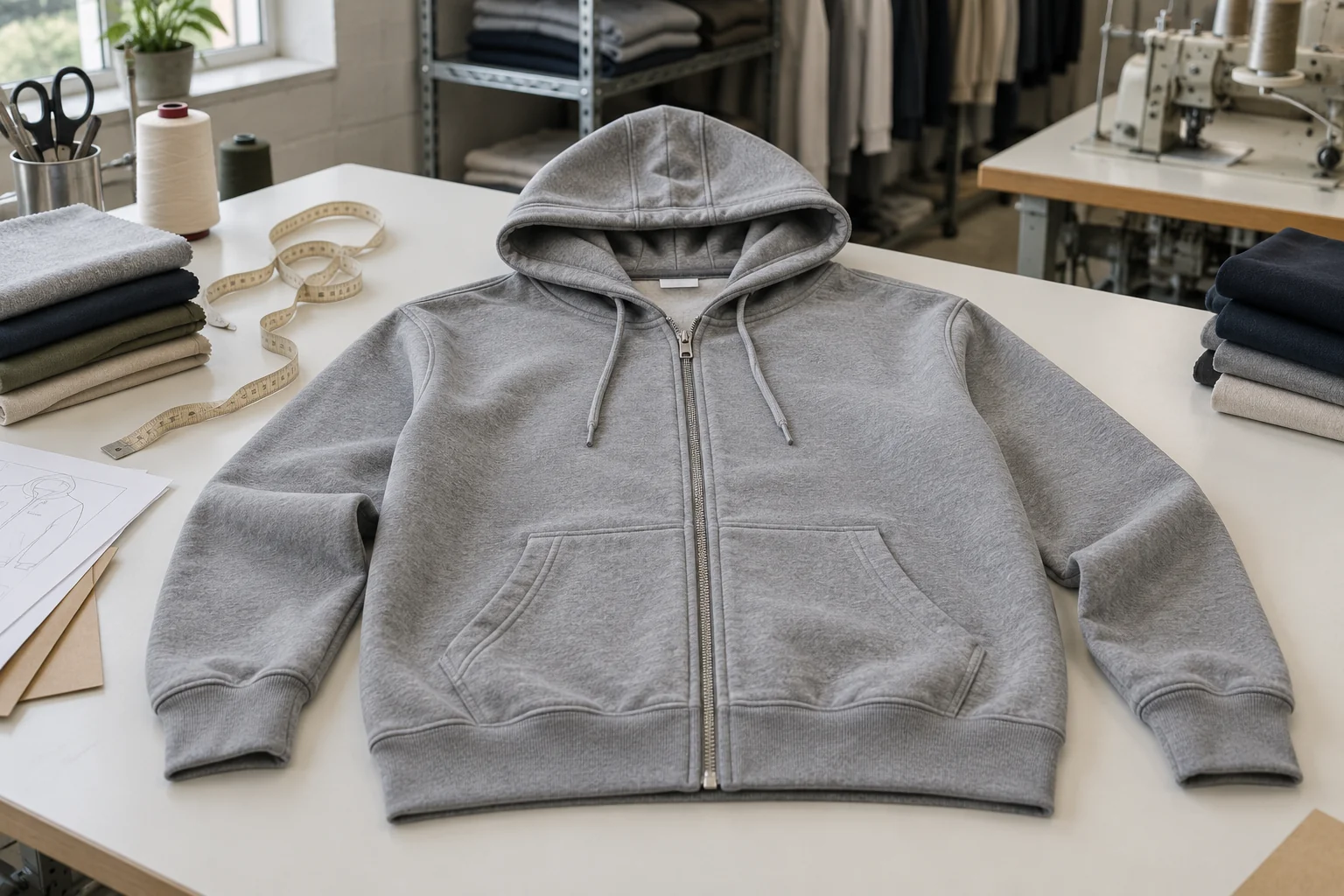
Briefing a zip up hoodie manufacturer starts with defining a complete opening system, not simply adding a zipper to a pullover pattern. Specify zipper construction, length, color, puller, front finishing, pocket layout, and the hood-to-neck junction alongside fabric GSM and rib requirements. MOQ 100 pcs per color per design should be checked against separate zipper, fabric, and decoration minimums. Samples take approximately 7 days once the brief and materials are confirmed; bulk timing depends on quantity, material readiness, and approvals. Approve the actual zipper installation, closed-front balance, pocket alignment, and decoration clearance before releasing the full-zip hoodie for production.
At a glance
Swipe the table sideways to compare both columns →
| Briefing point | Evidence to request | Approval control |
|---|---|---|
| Full-length opening | Zipper specification, graded lengths, puller reference, and color samples | Approve the complete separating zipper and its installation |
| Front and pocket construction | Inside and outside drawings, pocket dimensions, and closed-front photographs | Check front balance, pocket symmetry, and access |
| Hood and neckline junction | Top-stop placement, seam sections, and hood attachment sample | Review throat comfort and operation with the hood up and down |
| Fabric and rib behavior | Body GSM, rib specification, dimensional-change findings, and finished sample | Review zipper waviness, hem level, and cuff recovery after care |
| Decoration and production release | Zipper clearance dimensions, decorated sample, and approval record | Release only the documented material and construction combination |
1. Give the zip up hoodie manufacturer a complete opening brief
Start with front, back, and inside drawings that show a full-length opening from the hem to the neckline. State whether the silhouette is regular, relaxed, or oversized, then provide finished garment measurements and the intended size range. Mark the center-front reference, zipper endpoints, shoulder position, hood seam, pocket placement, and rib attachment lines. Explain whether measurements are taken with the zipper closed and the garment laid flat without stretching. Include a bill of materials that identifies the body fabric, hood lining if used, rib, zipper, sewing thread, labels, and decoration. A photograph can communicate appearance, but it should not replace dimensions or construction notes. Ask the factory to return an annotated review identifying missing details, proposed defaults, and any features that require development before it quotes the program or starts the first pattern.
Keep this brief distinct from a half-zip sweatshirt brief. A full-zip hoodie normally needs a separating zipper, two finished front edges, and controls for left-to-right balance throughout the opening. A half-zip opening ends within the body and requires a different lower junction and reinforcement approach. Do not carry its zipper length, pocket pattern, or front allowance into the full-zip style without review. Use the /zip-up-hoodie-manufacturer page to establish the intended product scope, then make the purchase specification more precise than the category description. Record MOQ 100 pcs per color per design and provide a size allocation for each combination. Ask whether any fabric, custom puller, tape color, or decoration requirement creates a separate minimum commitment. Resolve those commitments before approving the design, especially when leftover components would belong to the buyer.
2. Specify zipper type, length, color, and puller together
Identify the zipper construction rather than requesting a generic heavy-duty zipper. State whether the intended appearance calls for coil, molded elements, or metal elements, and request the supplier's component designation and a physical reference. Confirm a separating bottom and whether the design needs a one-way or two-way opening. Define length using an agreed measurement convention, with endpoints shown on the drawing, because overall tape length and functional chain length are not interchangeable. Give the required zipper length for each size or ask the factory to propose a grading schedule for approval. Specify element color, tape color, slider finish, puller shape, and any logo orientation separately. Review tape against both the face fabric and exposed inside surfaces. A matching color description alone does not establish an acceptable shade relationship across different materials.
Ask how the proposed slider and puller work with the selected chain and separating components, rather than treating the puller as an independent cosmetic purchase. Record whether the slider is locking and what operating behavior the buyer expects during wear. Request a sample that can be opened, closed, and separated repeatedly in the actual garment, including at the hem where rib and seam allowances can restrict access. Check that the puller is comfortable to grasp and that the insertion area remains reachable without pulling the garment out of shape. For custom components, confirm development approval, minimums, replacement availability, and supply timing before booking production. The related guide how-to-brief-hoodie-zippers-pullers can support the component specification, but final approval must still cover installation. A loose zipper sample does not demonstrate how the finished hoodie will hang or operate.
3. Resolve front finishing and pocket construction as one layout
Use a cross-section sketch to explain what the buyer means by placket. The requirement may be an exposed zipper with turned front edges, a covered opening, an internal facing, or an internal guard behind the zipper. Specify which parts are visible when the garment is open and closed. Mark seam allowances, fold lines, topstitch positions, tape exposure, and the finished distance between each front edge and the zipper elements. Ask the factory how it will stabilize the opening without making the front noticeably stiff. Review the bottom junction where the zipper, body fabric, hem rib, and any facing meet. Excess thickness can make the separating components difficult to engage, while unequal front lengths can leave the hem uneven. Approve an inside view as well as an outside view so hidden finishing is not left to assumption.
Choose split kangaroo pockets or welt pockets explicitly, then dimension the selected construction from stable references such as center front and the finished hem seam. For split kangaroo pockets, mark the opening angle, pocket height, inner edge position, top corners, and reinforcement locations on both halves. Confirm whether pocket edges align across the closed zipper and whether an intentional gap remains at center front. For welt pockets, show the opening length, angle, welt width, pocket bag shape, and how the bag is secured internally. Check that a pocket bag or attachment seam cannot enter the zipper operating path. Ask for hand-access evaluation in the sample size and review the smallest and largest sizes for proportion. Pocket symmetry should be assessed with the garment closed and laid naturally, not pulled into alignment for a photograph.
4. Define the hood attachment and zipper-top junction
Draw the hood attachment at center front so the factory can see where the zipper ends relative to the neckline seam and hood opening. State whether the zipper reaches the neck seam, continues into a raised front section, or stops below a separately finished edge. Specify any zipper guard or protective tab and show which side it covers. Identify the hood construction, lining, panel arrangement, front edge finish, and seam coverage at the neck. If a drawcord is included, locate exits and internal channels so they do not interfere with the slider or create an unintended thick junction. Ask for an inside construction photograph before accepting the sample. The visible front can appear clean while stacked allowances, exposed tape ends, or uneven hood attachment make the neckline uncomfortable or difficult to reproduce consistently.
Review the hoodie fully closed, partially open, and fully open, with the hood both raised and resting on the back. Look for pulling at the throat, a tilted zipper top, asymmetric hood edges, and front panels that rotate when the hood's weight changes. Check the neck seam and shoulder balance before asking the factory to correct the zipper alone; the apparent opening defect may originate elsewhere in the pattern. Confirm that the top stop and puller do not press against the wearer in the intended closed position. Record any changes to hood depth, opening shape, or front height as pattern revisions, not informal sample comments. For size grading, ask how the hood and neckline are coordinated across the range. Approval of one comfortable sample size does not establish acceptable hood attachment or closure height in every size.
5. Coordinate fabric GSM, cuff and hem behavior, and decoration clearance
Specify body fabric composition, knit construction, GSM, surface finish, and the condition in which weight is assessed. Identify whether the inside is brushed, looped, or otherwise finished, and approve a labeled material reference rather than weight alone. Give the hood lining its own specification when it differs from the body. For cuffs and hem, define rib construction, composition, finished dimensions, and the intended amount of gathering at attachment. Ask the factory to propose rib lengths against the actual body fabric and pattern, then review recovery and appearance on the sample. Fabric, rib, and zipper tape can respond differently to laundering and finishing, which may contribute to a wavy opening or an uneven hem. Request dimensional-change findings under an agreed care procedure and verify the complete garment rather than relying only on separate material reports.
Place decoration using dimensions from the finished center-front opening and other stable garment references. State whether the artwork should appear continuous across the closed zipper or remain visibly separated on the two front panels. Define a no-decoration zone around the tape, elements, slider path, and thick front seams, with the clearance proposed for the selected printing or embroidery process. There is no single suitable clearance for every construction, so require the decorator and sewing factory to confirm the actual layout. Ask whether decoration occurs before or after zipper installation and how that sequence affects registration, hoop access, pressing, and handling. Approve artwork on the real fabric with the intended backing or application route. Examine the decorated hoodie closed and open, then reassess after the agreed care procedure for distortion, seam puckering, and interference with zipper movement.
6. Set sample gates and a documented bulk release
Separate development approval from production release. Samples take approximately 7 days once the brief and materials are confirmed, but unavailable zipper lengths, custom pullers, new fabric, decoration trials, shipping, and revisions need separate scheduling. Ask which materials in the first sample are production-intended and label every substitute. Use the first review to evaluate fit, closed-front balance, opening operation, pocket access, hood attachment, and inside finishing. Measure the garment using the agreed method and record findings before and after the specified care procedure where required. Send one consolidated correction sheet with photographs, dimensions, and a revision identifier instead of conflicting comments across messages. If a correction changes the zipper length, rib ratio, front pattern, or hood junction, ask whether another complete sample is needed. Do not approve an unresolved structural change only from a loose component or cropped photograph.
Before cutting bulk, require a production reference using the approved fabric, zipper, rib, decoration, labels, and construction route. Confirm the size set or other grading checks appropriate to the order, especially where zipper lengths change between sizes. Attach the approved measurement chart, tolerances, component references, artwork placement, and defect review criteria to the purchase order or controlled specification. Bulk timing depends on quantity, material availability, capacity, and the speed of approvals; ask for milestones rather than an unsupported fixed completion promise. Establish incoming checks for zipper lengths and colors, an early sewing review for front balance, and final checks for operation, pocket symmetry, measurements, and appearance. Require written review of substitutions before use. Record who authorizes release, how nonconforming pieces are handled, and which retained sample governs any disagreement about the completed order.
Send these details together
- Issue full-zip drawings, finished measurements, size allocation, and MOQ 100 pcs per color per design assumptions.
- Approve separating zipper construction, graded lengths, tape and element colors, slider behavior, and puller reference.
- Define front finishing, bottom junction, pocket type, pocket symmetry, and inside construction.
- Review hood attachment, zipper-top protection, neckline comfort, and operation in open and closed positions.
- Qualify body GSM, hood lining, cuff and hem rib, decoration clearance, and post-care appearance together.
- Release bulk against a documented production reference, revision record, inspection criteria, and substitution controls.
This guide covers buyer-side China menswear OEM planning for full-zip hoodie programs, including zipper installation, front finishing, pockets, hood attachment, materials, and decoration. It does not replace a separate half-zip construction brief. MOQ 100 pcs per color per design is the starting garment requirement; confirm size allocation and separate material or component minimums. Samples take approximately 7 days once the brief and materials are confirmed; bulk timing depends on quantity, materials, capacity, and approvals. Reprint attribution: hoodiemanufacturerchina.com.
Prepare a quote briefThe RFQ form prepares a WhatsApp message for you to review. For files, email sales@hoodiemanufacturerchina.com.
Questions before sampling
Can a pullover hoodie pattern be used for a full-zip version?
It can be a development starting point, but it should not be released unchanged. The factory must resolve front allowances, zipper length, hem junctions, pocket separation, and hood attachment. Confirm finished measurements with the zipper closed and review how the open garment hangs. The zip-up-vs-pullover-development guide provides a useful comparison, but the actual full-zip sample remains the approval reference.
Does MOQ 100 pcs per color per design include custom zipper components?
That figure is the starting garment requirement, not confirmation that every component is available at the same minimum. Custom tape colors, pullers, finishes, or length combinations may involve separate purchasing commitments. Request component minimums and available stock options before approving the bill of materials. Record ownership and handling of any surplus so the garment order does not conceal an additional material obligation.
How much clearance should artwork have around the zipper?
Agree clearance against the actual zipper installation and decoration process rather than applying a universal distance. The layout must account for tape exposure, element width, slider movement, seam thickness, and equipment access. Have the factory and decorator mark the excluded area on the artwork drawing. Approve a decorated garment sample, including its closed-front appearance and operation after the agreed care procedure.
What should be checked before approving the full-zip sample?
Check fit and measurements, zipper engagement and travel, level hems, front balance, pocket alignment, hood attachment, and the inside finish. Review the garment open and closed, with the hood raised and lowered. Identify substitute materials and unresolved revisions explicitly. Where laundering is part of the review, assess the complete garment afterward for opening waviness, dimensional change, decoration distortion, and operating interference.
What are your MOQ, sample time and bulk lead time?
MOQ is 100 pcs. Samples take 7 days. Bulk production lead time depends on order quantity.