How to Brief a Pullover Hoodie Manufacturer
Briefing a pullover hoodie manufacturer starts with defining how the garment fits, passes over the head, and supports decoration without a front opening. Specify hood volume, drawcord construction, kangaroo pocket geometry, hem treatment, fabric GSM, and handfeel as connected decisions rather than separate styling notes. Plan around MOQ 100 pcs per color per design, with fabric and trim minimums checked separately. Samples take approximately 7 days once the brief and materials are confirmed; bulk timing depends on quantity, material readiness, capacity, and approvals. Use measured samples and actual-material trials to resolve neckline stretch, shrinkage, and decoration clearance before releasing production.
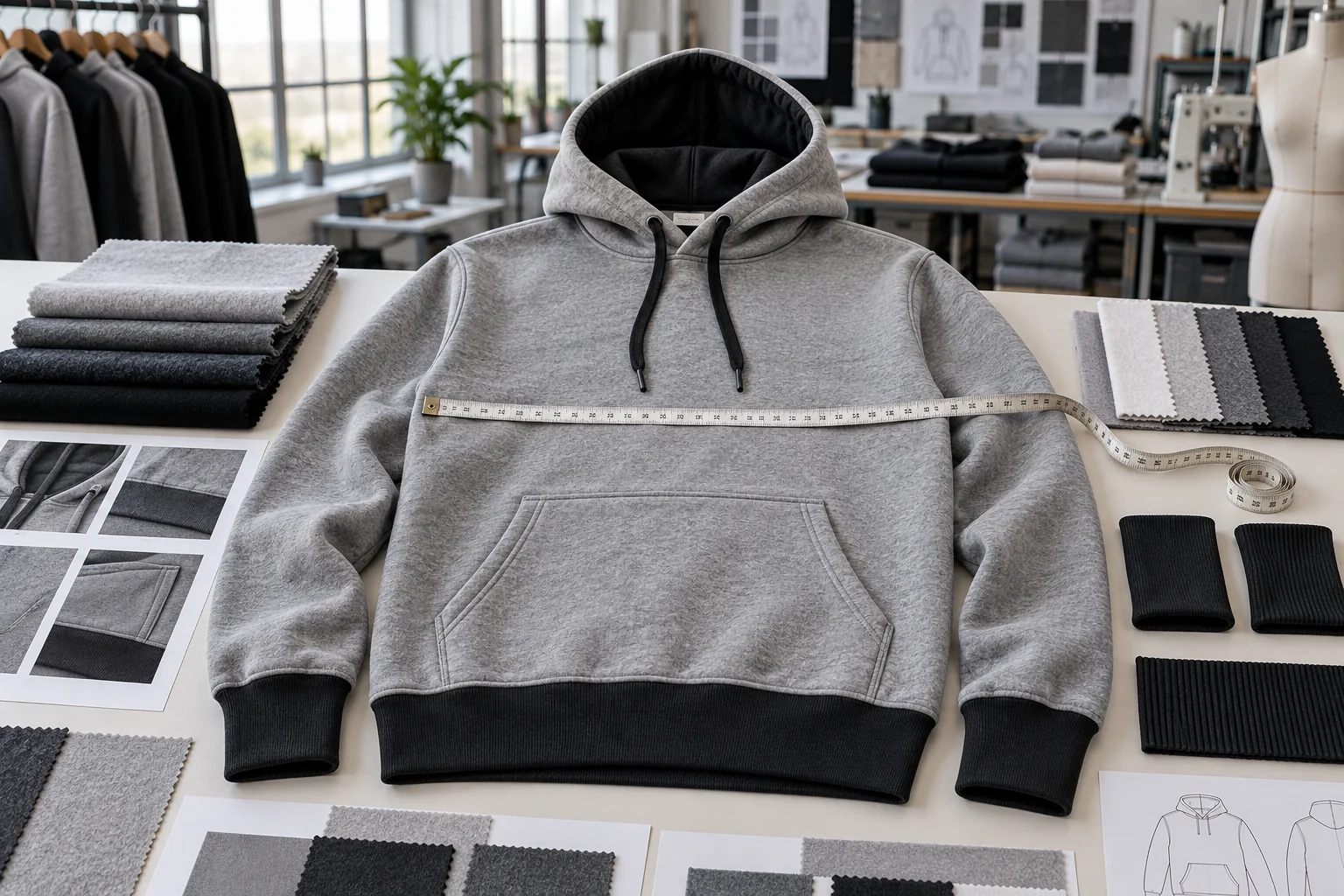
At a glance
Swipe the table sideways to compare both columns →
| Briefing point | Evidence to request | Decision or control |
|---|---|---|
| Fabric and handfeel | Identified fabric article, conditioned GSM, finish details, and wash trial | Approve weight, surface, drape, and dimensional behavior together |
| Hood and head entry | Hood measurements, panel construction, neckline trial, and recovery review | Confirm volume and usable opening on the actual assembled garment |
| Drawcord and pocket | Cord specification, attachment details, pocket dimensions, and placement diagram | Resolve functional construction and destination-market requirements |
| Hem and decoration | Rib or self-hem specification and graded chest clearance layout | Approve silhouette and artwork position without relying on the base size alone |
| Quantities and release | Color-size matrix, component minimums, sample reports, and approval register | Plan from 100 pcs per color per design and release only the documented specification |
1. Give your pullover hoodie manufacturer a measurable brief
Begin with a front, back, and hood drawing supported by a measurement chart, not a collection of reference images alone. Identify the intended wearer, size range, fit direction, and wearing conditions so the factory can interpret proportions consistently. State whether the body is straight, tapered, or deliberately bloused, and define shoulder position, body length, sleeve volume, and cuff opening. Mark measurement points and explain whether dimensions apply before or after the agreed care procedure. A pullover has no front opening to assist dressing, so neckline access and hood attachment must be reviewed alongside appearance. Compared with a zip-up, the uninterrupted front offers a broader decoration area but places different demands on head entry and front-panel layout. Keep the brief focused on those differences rather than borrowing zipper-related measurements or assuming an existing zip-up block can simply lose its closure.
Issue a controlled technical package that names the style, revision, sample size, fabric proposal, construction details, and unresolved decisions. Separate mandatory requirements from preferences that the factory may develop, such as alternative hood seams or pocket reinforcement methods. Ask the supplier to return a written feasibility review identifying missing dimensions, conflicting tolerances, unavailable components, and operations assigned to outside facilities. Define who can approve pattern changes, material substitutions, decoration revisions, and labeling content. A supplier suggestion should remain a proposal until it is recorded in the current specification. Include an approval register so a comment on body length cannot be mistaken for acceptance of fabric, artwork, or drawcord details. Before requesting a firm production quotation, reconcile the drawing, measurement chart, bill of materials, and quantity matrix. Contradictory documents often produce different interpretations even when each individual document appears complete.
2. Specify GSM and handfeel as a material system
Describe the shell fabric through composition, knit construction, target GSM, measurement condition, usable width, face appearance, and inside finish. Distinguish brushed fleece from loopback construction and state whether the desired handfeel is compact, dry, soft, lofty, or fluid. These descriptions should lead to physical references rather than remain subjective purchasing language. Two fabrics with similar GSM can behave differently because of yarn choice, knitting structure, finishing, and fiber content. Request an identified article and retain a labeled swatch with the approved face and reverse clearly marked. Ask whether the quoted material is reserved stock, shared stock, or a custom production commitment. Confirm color availability and replenishment assumptions before approving consumption or delivery planning. If the supplier proposes a substitute, review it as a new material decision rather than accepting matching weight as sufficient evidence of equivalence for the finished hoodie.
Evaluate the fabric in the intended garment and care route, including any garment wash, brushing, softening, or decoration cure that may affect the final result. Request dimensional-change observations in both directions and use them to establish pattern allowances rather than applying an unexplained general allowance. Review twisting, surface change, pilling tendency, color transfer, and shade consistency according to the product's intended use and agreed evaluation methods. Compare handfeel after care with the retained reference, because an attractive initial finish may not represent the garment customers will continue wearing. Include hood lining, pocket fabric, and rib in compatibility checks instead of testing the shell alone. Different shrinkage behavior can distort the hood edge, pull the pocket, or create an uneven hem. Record approved material combinations and the party responsible for reviewing new lots. Testing supports a decision only when its sample identity and conditions are traceable.
3. Connect hood volume, neckline stretch, and drawcord details
Define hood height, depth, face opening, overlap at the front neckline, and the method used to measure each point. State whether the hood uses two panels, three panels, a lining, or a folded edge, and show seam positions on the drawing. The same outer dimensions can produce different volume and drape when panel geometry or lining changes. Review the hood both raised and resting on the back, checking face coverage, side visibility, shoulder balance, and any backward pull on the neckline. Specify the neck seam finish and the stretch behavior needed across every construction layer, including tape, stitching, lining, and overlapping hood ends. An elastic shell does not guarantee an accessible assembled opening. Conduct a practical head-entry review on the intended fit population and inspect recovery afterward. Do not solve restricted entry solely by enlarging the opening without checking neckline shape and hood stability.
For a drawcord version, specify cord material, construction, width or diameter, color, finished length, end treatment, and the intended exposed length under a defined adjustment condition. Locate exits from fixed seam references and identify whether they use sewn eyelets, hardware, or another approved construction. Include backing or reinforcement details and review the interaction between cord movement and the hood edge. Ask the factory to demonstrate the assembled channel rather than approving a loose cord and eyelet separately. Determine destination markets and wearer age classification before finalizing cords, attachments, or decorative ends, since applicable restrictions can change the design. Do not assume that a standard supplier cord arrangement is suitable for every market. If the hoodie is cord-free, document that choice and remove redundant exits from the specification. Review attachment security and appearance after care, and agree how damaged hardware or cord substitutions will be handled.
4. Engineer the kangaroo pocket and hem together
Specify kangaroo pocket width, height, opening length, opening angle, and location relative to the center front and finished hem. Show whether the pocket is one continuous piece and whether its lower edge sits above the hem seam or is incorporated into it. Define seam allowances, edge finishes, topstitching, and reinforcement at the hand openings. A front-view drawing alone may hide an opening that is difficult to use or a pocket that hangs away from the body. Review access with the intended sleeve volume and wearer posture, not only on a flat table. Check pocket symmetry, corner shape, stretch at the openings, and distortion after care. Ask how placement will be controlled during sewing and how the pocket will be graded across sizes. Retain a measured sample or placement template so production does not rely on an operator's visual estimate.
Choose rib or a self-fabric hem according to the intended silhouette, then define its construction rather than writing only rib bottom or straight hem. For rib, specify composition, structure, finished depth, joining seam, and the relationship between the relaxed band and body circumference. Review recovery and color matching with the shell, while recognizing that different structures may reflect light differently. Excessive band tension can create unwanted blousing or distort a pocket caught in the seam. For a self-fabric hem, state the turnback depth, stitch arrangement, finished opening, and whether reinforcement or other stabilization is required. Confirm enough movement at the hip without assuming that a straight-looking hem has adequate stretch. Review cuffs with the same attention to recovery and attachment. Approve the pocket and hem together after care because their seam positions and differential shrinkage can change the finished front balance.
5. Map decoration clearance on the uninterrupted chest
Use the continuous front panel deliberately, but do not treat all visible chest space as usable decoration area. Provide artwork dimensions, color separations where relevant, application method, and placement measured from stable construction references. Show clearance from the neckline, lowered hood, armholes, and upper pocket edge, including the pocket's reinforcement zones. A large graphic may look centered on a flat drawing but disappear beneath the hood or crowd the pocket when worn. Ask the factory and decorator to check access, equipment limitations, and the intended assembly sequence before confirming feasibility. Some applications are easier on cut panels, while others suit completed garments; each route needs alignment and traceability controls. Specify whether the graphic is centered on the body, the neckline, or another deliberate reference. Avoid instructions such as standard chest position unless a dimensioned approved reference defines exactly what standard means.
Prepare a size-by-size placement plan that states whether artwork dimensions remain constant or change at specified size breaks. Review the smallest and largest ordered sizes, not only the base-size sample, because available space and perceived placement change with grading. Request an application trial on the actual fabric and finish, checking color, edge definition, coverage, stretch response, surface distortion, and handfeel as appropriate to the method. Embroidery may require backing and can stiffen the chest; printing may respond differently to a brushed surface, dye, or softening treatment. Evaluate the decorated trial after the agreed care procedure and any subsequent production finishing. Identify who approves artwork files, application settings, and physical results, and retain a labeled reference. A digital mockup can approve composition but cannot establish application performance. If decoration changes, reopen the affected material, placement, and garment reviews rather than treating artwork approval as blanket authorization.
6. Reconcile minimums and establish sample release gates
Plan around MOQ 100 pcs per color per design and submit a matrix listing each design, color, size, and decoration version. Ask how changes in artwork, hood construction, or hem treatment affect the supplier's definition of a separate design. Confirm accepted size allocations instead of assuming every size can be ordered in any quantity. Keep fabric dyeing, rib, drawcord, labels, packaging, and decoration setup commitments separate from the garment minimum. Request visibility on development consumption, surplus components, and who owns or stores unused branded inventory. Samples take approximately 7 days once the brief and materials are confirmed; that allowance does not cover every revision, custom material lead time, or transit period. Bulk timing depends on quantity, material readiness, production capacity, decoration scheduling, and approvals. Ask for a dependency-based schedule showing when decisions are needed and which operations remain blocked if an approval is late.
Define separate gates for fit, material behavior, decoration, and the final preproduction garment, allowing submissions to be combined only when they genuinely prove the same requirements. A substitute-fabric fit sample cannot establish final neckline recovery, hood drape, or shrinkage. Before bulk release, review an actual-material garment with the intended hood, cord, pocket, hem, decoration, labels, and finishing route. Record measurements, head-entry observations, care results, workmanship findings, and any accepted deviations against named specification versions. Retain matching references with buyer and supplier and require written authorization before cutting or other irreversible work proceeds. Attach an inspection plan covering sizes, colors, material lots, pocket placement, decoration clearance, and packing details. Agree how nonconforming goods will be held, investigated, corrected, and presented again. Changes to fabric, construction, decoration, or production site should trigger review of the affected approvals rather than silently inheriting the original release.
Send these details together
- Issue revision-controlled drawings, measurement points, tolerances, fit intentions, and a responsibility and approval register.
- Identify the shell, lining, and rib articles; approve GSM, handfeel, shade, and dimensional behavior through the intended care and finishing route.
- Measure hood volume and neckline access on the assembled garment; resolve drawcord specifications and destination-market requirements.
- Define kangaroo pocket geometry, reinforcement, grading, and its relationship to the approved rib or self-fabric hem.
- Approve actual-fabric decoration trials and graded placement clearances from the hood, neckline, armholes, and pocket.
- Confirm MOQ 100 pcs per color per design, separate component commitments, sample gates, bulk release records, and change-control requirements.
This guide covers buyer-side briefing of China pullover hoodie OEM production, including fabric selection, hood construction, neckline access, drawcords, kangaroo pockets, hem treatments, decoration, and approval gates. It does not provide a complete zip-up hoodie specification or replace destination-market product safety and labeling review. MOQ 100 pcs per color per design is the garment planning basis; confirm size allocation and separate material and component minimums. Samples take approximately 7 days once the brief and materials are confirmed; bulk timing depends on quantity, material readiness, capacity, and approvals. Reprint attribution: hoodiemanufacturerchina.com.
Prepare a quote briefThe RFQ form prepares a WhatsApp message for you to review. For files, email sales@hoodiemanufacturerchina.com.
Questions before sampling
Can a zip-up hoodie pattern be used for a pullover?
It can be a development starting point, but removing the zipper does not establish a finished pullover pattern. The factory should review front width, neckline access, hood overlap, pocket construction, and decoration space. Confirm head entry and recovery on an assembled sample in the intended material. Keep any reused block subject to the pullover measurement chart and approval gates.
Is GSM enough to specify pullover hoodie fabric?
No. GSM describes mass per unit area under the stated measurement condition, not the complete handfeel or performance of a fabric. Include composition, knit construction, inside finish, face appearance, and an identified article. Approve a physical reference and review dimensional change, drape, surface behavior, and compatibility with rib, lining, and decoration through the intended finishing and care route.
Should a pullover hoodie use rib or a self-fabric hem?
Choose according to the intended silhouette and movement requirements. Rib can draw the body inward, but its tension and recovery need approval to avoid excessive blousing. A self-fabric hem can support a straighter appearance, but its opening and stitch construction still need adequate movement. Review both options with the kangaroo pocket attached and after the agreed care procedure.
Does a seven-day sample approve the hoodie for bulk production?
Not automatically. Approximately 7 days is a sample planning allowance once the brief and materials are confirmed, not a guarantee that all development is complete. The sample may address only fit or construction. Bulk release should depend on documented approval of the actual materials, hood and neckline behavior, pocket and hem, decoration, labels, and any outstanding deviations.
What are your MOQ, sample time and bulk lead time?
MOQ is 100 pcs. Samples take 7 days. Bulk production lead time depends on order quantity.